


SKIN
Microneedling at Home or in a Clinic: What’s Different
In Brief
- Same name, two different things: a microneedling product sold for home use may act only on the surface or may puncture the skin; its name, shape and number of needles do not tell you which.
- Risks at home: infection, scarring, irritation and changes in skin colour or texture are possible, especially when too much pressure is applied or the device is overused.
- Equipment: for medical devices, a new needle cartridge is used for each person and each session; cleaning a cartridge does not make it reusable.
- Before you start: an infection, a herpes outbreak, eczema, pregnancy, difficulty healing or a current or recent prescribed acne treatment taken by mouth are reasons to wait, to decide against it or to ask for advice.
- If your skin reacts badly: pus, yellow crusts, pain, warmth or fever require medical advice right away.
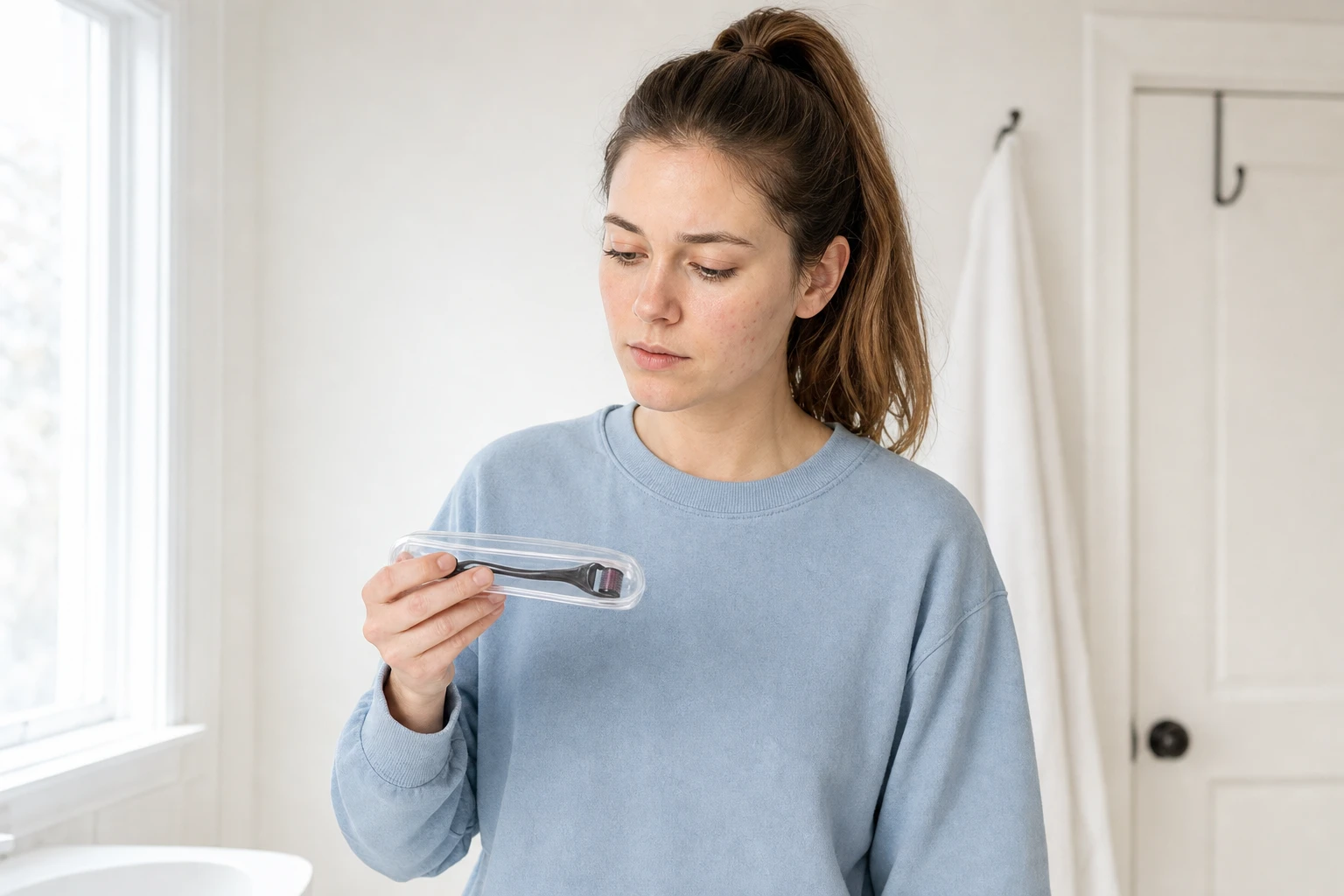
You have seen microneedling rollers and pens sold to the general public, and you are wondering whether at-home microneedling could replace a session in a clinic. The tool has the same name in both cases, but what it does to the skin, the risks it carries and what is planned if the skin reacts badly are not the same.
What Microneedling Does to the Skin
Microneedling is a medical treatment that uses tiny needles to puncture the skin. When it is done properly, the skin responds by closing these punctures and producing collagen, the protein that supports its tissues. A puncture is still a small injury that the skin has to repair: this is what links the intended effect to the risk.
CARE MD, in Sainte-Thérèse, on Montreal’s North Shore, offers microneedling for the face, neck and upper chest. The starting point of the assessment is what you want to change; your health, your treatments and how your skin heals are also taken into account. During the assessment, you can ask your questions about the expected result, the number of sessions and recovery; neither a result nor a timeline is guaranteed.
What the Name Does Not Tell You: Surface Action or Puncturing the Skin
Two kinds of products are sold under the name microneedling. Some do not penetrate the living layers of the skin, the epidermis and the dermis, and claim to act only on the surface; in the United States, they are generally not considered medical devices. Others are medical devices that puncture the skin, and on some motorized devices, the person performing the session sets the depth and speed at which the needles penetrate.
Whether it is a facial microneedling roller or a needle pen, the shape, the number of needles and the trade name do not tell you how deep it goes or what the risk is. A product sold for home use can therefore puncture the skin, while another will only graze its surface.
What Is Different in a Clinic
A professional setting does not guarantee the result you want or the absence of side effects: most side effects appear shortly after the session and go away. Some persist for a long time or can be permanent. What is different is the means available to reduce the risks and to respond.
- The examination before the procedure
-
Questions about your health and expectations, followed by an examination of your skin, to determine whether microneedling is safe for you and whether it can deliver what you expect. It may lead to postponing the procedure or deciding against it.
- The equipment
-
A new needle cartridge for each person and each session.
- The depth
-
On some motorized devices, the depth and speed at which the needles penetrate can be adjusted.
- Training
-
The person performing the procedure must be trained in microneedling, and you can ask about their experience.
- The plan if a complication occurs
-
The person must know the signs of a complication and how to manage your care, through treatment on site or immediate referral to another healthcare professional.
The Risks of Microneedling at Home
A product intended for home use can still puncture the skin, which opens the door to infection or scarring. Facial microneedling at home can also spread warts, herpes and other viruses from one area of the skin to another.
Too much pressure can damage the skin and leave scars or change its colour or texture. Overuse irritates the skin, makes it uncomfortable and can worsen the problem you wanted to correct. Darker spots or paler areas, in other words changes in pigmentation, are also among the risks described for this procedure.
The at-home microneedling trend on TikTok was the subject of a Radio-Canada report (in French): many young people copy the technique at home, without supervision or a sterile environment. A video is no substitute for the skin examination that comes before the procedure in a professional setting, or for a plan in case of complications.
Seek care right away
Seek care right away
After microneedling done at home, some signs suggest an infected wound: pus, yellow or golden crusts, pain, skin that turns red, purplish or brown, swelling or warmth, red streaks (reddish-brown on darker skin), fever or feeling very hot or very cold. If you notice any of these, seek care right away. These signs are not enough to make a diagnosis, but they warrant prompt medical advice.
Equipment: What Cleaning Does Not Solve
For medical devices that use a needle cartridge, a new cartridge is used for each person and each session, even for the same person. Reusing a cartridge is not safe, even after cleaning, and using it on more than one person can transmit infectious agents. The cartridge and the rest of the device therefore do not raise the same issue: the cartridge must be new for each session; for the device, ask how it is cleaned between people. Cleaning a cartridge does not make it safe to reuse.
Serums and Cosmetics: Intact Skin or Punctured Skin
A serum designed for intact skin is not necessarily suitable for punctured skin. In fact, in the United States, microneedling devices are not authorized to deliver cosmetics, topical products or vitamin solutions into the skin. A rare inflammatory skin reaction, called a granulomatous eruption, is possible after microneedling with a vitamin C serum. The ingredient responsible may remain unknown.
Tolerating a cosmetic product well every day, such as a vitamin C cosmetic product, does not tell you how your skin will react if that product is introduced through the punctures. Adding a serum to microneedling does not guarantee an additional benefit.
When to Decide Against Microneedling or Ask for Advice First
Before any microneedling, including microneedling you would do yourself, certain situations are reasons to wait, to ask for advice or to decide against it.
- Avoid
-
Slow or poor healing, a history of keloids (raised scars) and an immune system weakened by an illness or a medication.
- Wait until healed
-
A skin infection, a sunburn, a recent tan, or pimples that are painful, filled with pus or deep. Wait until these have healed.
- Ask for advice first
-
A current herpes outbreak, in other words cold sores, current or past eczema, pregnancy or breastfeeding, or a current or recent prescribed acne treatment taken by mouth. In these cases, ask for advice before deciding.
Never change how you take a prescribed medication on your own initiative. If you are taking, or have recently taken, a prescribed acne treatment by mouth, say which one and when: the doctor checks the waiting period that applies to that treatment. If any of these situations applies to you, microneedling at home is not an option; an assessment is an opportunity to determine whether the procedure, adapted or postponed, is still possible.
Questions to Ask Before You Decide
Wherever microneedling is offered to you, these questions let you compare answers rather than promises:
- What is assessed before the procedure: your health, your medical history, your prescribed treatments and how your skin heals?
- What training does the person performing the procedure have, and what is their experience with microneedling?
- Is a new cartridge used for each person and each session, and how is the device cleaned between patients?
- The equipment looks clean, but how is its sterility checked?
- Is the device licensed by Health Canada, and is there an information leaflet for patients?
- What written instructions should I follow after the session?
- Whom should I contact, and how, if my skin reacts badly?
- What happens if a complication occurs, and who manages it?
- What are the risks in your situation, and what can you reasonably expect from the treatment?
Also mention what you have already tried at home. You can decide to wait or decide against it: not having any treatment is one of the options. If your goal is mainly to care for intact skin, simple facial treatments are another option to discuss, without puncturing the skin.
Microneedling at Home: What It Does Not Guarantee and What Calls for Caution
At CARE MD, the assessment is an opportunity to determine whether microneedling is appropriate for your situation.
Insist on a new cartridge for each session and each person; even after cleaning, it must not be reused.
Do not have microneedling if you heal slowly or poorly, have had a keloid or have a weakened immune system. If you have an infection or painful pimples, wait until they have healed.
Ask for advice first if you have a herpes outbreak or eczema, are pregnant or breastfeeding, or are taking or have recently taken a prescribed acne treatment by mouth. Do not change how you take your treatment without medical advice.
Seek care right away if you notice pus, yellow or golden crusts, pain, red, purplish or brown skin, swelling, warmth or fever.
At home, puncturing your skin injures it; an infection, scarring or changes in skin colour or texture can then occur.
Do not rely on a “for home use” label: the product can still puncture your skin.
Even with a professional, you have no guarantee of a result or of avoiding side effects, which are sometimes long-lasting or permanent.
Tolerating your serum well in daily use does not mean that you can apply it to punctured skin.
Frequently Asked Questions
Can a Microneedling Roller or Pen Sold for Home Use Puncture the Skin?
Yes, this can happen even with a product intended for home use. Puncturing the skin opens the door to infection or scarring, and microneedling at home can spread warts, herpes and other viruses from one area of the skin to another. What the product is marketed for, its shape and its number of needles do not tell you how deep it goes or what the risk is.
Can a Needle Cartridge Be Cleaned and Reused?
No. For cartridge-based medical devices, a new cartridge is used for each person and each session, even for the same person. Reusing a cartridge is not safe, even after cleaning, and using it on more than one person can transmit infectious agents.
Can You Apply a Serum With a Microneedling Roller or Pen?
In the United States, microneedling devices are not authorized to deliver cosmetics, topical products or vitamin solutions into the skin. A rare inflammatory skin reaction, called a granulomatous eruption, is possible after microneedling with a vitamin C serum. The ingredient responsible may remain unknown. A product that is well tolerated on intact skin is therefore not automatically suitable for punctured skin.
Who Should Avoid Microneedling or Ask for Advice First?
Slow or poor healing, a history of keloids and a weakened immune system are reasons to decide against it. You need to wait until an infection, a sunburn, a recent tan, or pimples that are painful, filled with pus or deep have healed. A herpes outbreak, eczema, pregnancy, breastfeeding or a current or recent prescribed acne treatment taken by mouth are reasons to ask for advice before deciding; never change how you take a medication on your own initiative.
What Should You Do If Your Skin Reacts Badly After Microneedling at Home?
Pus, yellow or golden crusts, pain, red, purplish or brown skin, swelling or warmth, red streaks, fever or feeling very hot or very cold can signal an infected wound. In that case, seek care right away: a doctor assesses the situation. These signs are not enough to make a diagnosis, but they warrant prompt medical advice.
Does Microneedling in a Clinic Guarantee a Better Result?
No. It does not guarantee the aesthetic result you want or the absence of side effects: most side effects appear shortly after the session and go away. Some persist for a long time or can be permanent. What is different is the skin examination before the procedure, a new needle cartridge for each session and a plan for managing any complication.
What Questions Should You Ask Before Microneedling?
Ask what is assessed before the procedure, what training and experience the person performing it has, whether a new cartridge is used for each person and each session, how the device is cleaned between patients and whether it is licensed by Health Canada. Ask how the sterility of the equipment is checked and what written instructions to follow after the session. Ask whom to contact, and how, if your skin reacts badly. Also ask what happens if a complication occurs and who manages it. You can decide to wait: not having any treatment is one of the options.
Sources5 references+
- American Academy of Dermatology — Microneedling can fade scars, uneven skin tone, and more (opens in a new tab)
- FDA — Microneedling Devices (opens in a new tab)
- JAAD Case Reports — Sarcoidal granulomatous reaction to microneedling with vitamin C serum (opens in a new tab)
- American Academy of Dermatology — When to Use (or Not Use) Antibiotics on Your Skin (opens in a new tab)
- Radio-Canada Info — « Microneedling » à la maison, la mode TikTok qui laisse des marques [At-home “microneedling”: the TikTok trend that leaves marks] (opens in a new tab)

 CARE MD
A Question Before You Decide?
If you are unsure whether to choose microneedling at home or professional care, the Global Aesthetic consultation at CARE MD is an opportunity to ask your questions before making any decision.