


Skin Tags (Acrochordons): Causes and Treatment Options After Diagnosis
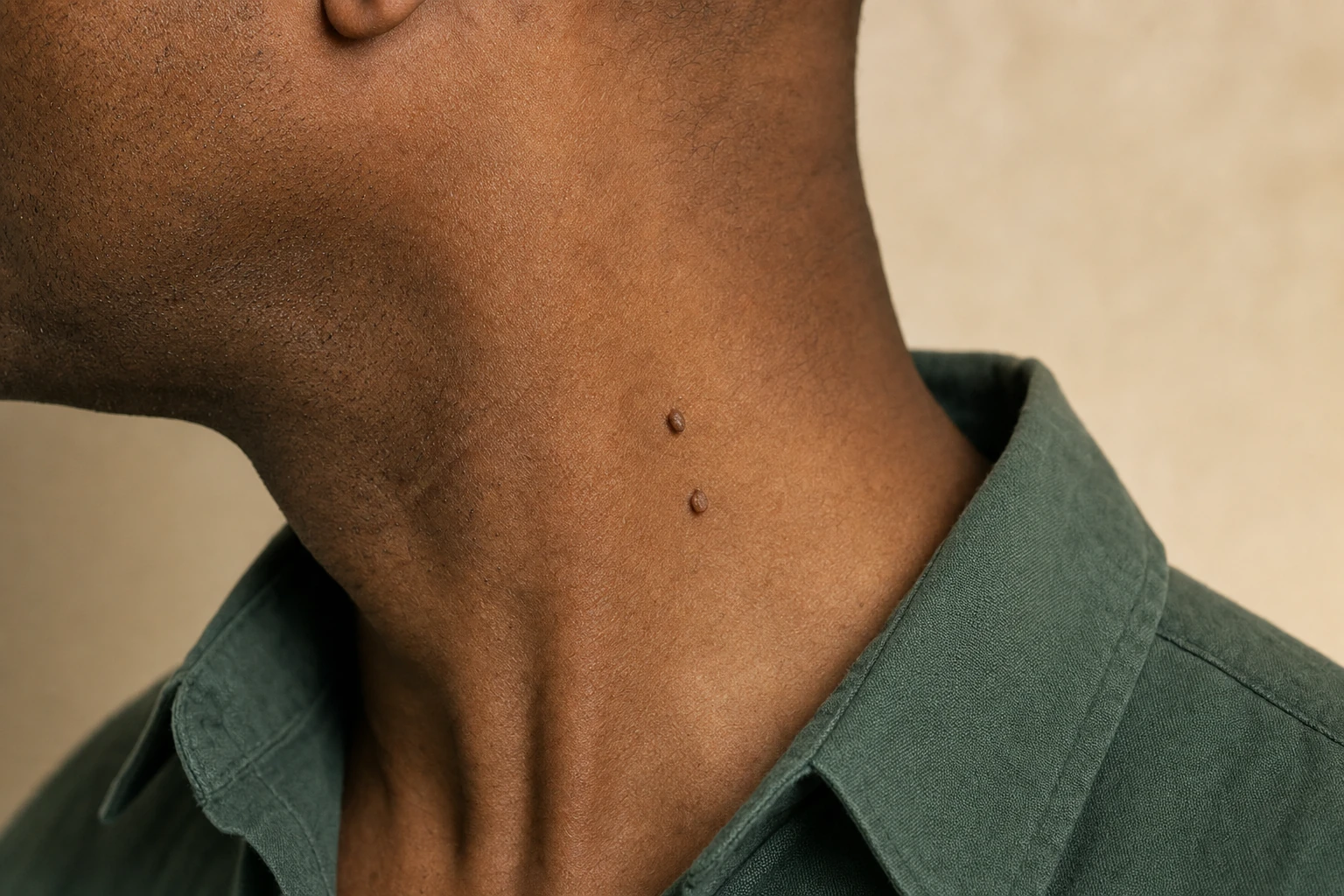
A small, soft growth has appeared in the crease of your neck, under an arm or in a skin fold, and your necklace, strap or collar rubs against it with every movement. You are wondering what it is, where it comes from, whether you should be worried about it and how to remove it without damaging your skin. A skin tag, also called an acrochordon, is a common growth that is usually harmless. Diagnosis comes first; removal is then discussed based on how much it bothers you and on the risks. Skin growths are a broader category that includes skin tags, one of the most common benign types.
- Diagnosis first
- Physician or nurse under supervision
- Sainte-Thérèse
At a glance
Five things to know before deciding- What it is: a small, soft, skin-coloured growth that is common and usually harmless. Only the doctor confirms this, on examination: a wart, or sometimes a skin cancer, can be mistaken for a skin tag.
- Why it appears: mainly where the skin rubs, on the neck, under the arms and in skin folds. Excess weight, pregnancy, family history and diabetes are associated with having more skin tags, although the cause is not always known.
- Removing it yourself: to be avoided, because of bleeding, infection, scarring and the possibility of being wrong about what the lesion is.
- At CARE MD: removal of a skin tag using plasma, cryotherapy or CO2 laser, depending on the lesion and the skin, after a diagnosis and an assessment, performed by a physician or a nurse under medical supervision. An identified skin tag that is not bothersome generally does not need to be removed.
- Risks and results: a scar and a darker spot are possible, especially on Black or brown skin; removal does not guarantee the absence of a mark or of new skin tags.
What Is a Skin Tag? Why Appearance Is Not Enough
A skin tag is a small skin growth that is soft to the touch and the same colour as the skin. Some are attached to the skin by a small, narrow stalk; not all are attached this way. Once it is identified as a skin tag, it is benign.
The tricky part is identifying it. A wart, and sometimes even a skin cancer, can be mistaken for a skin tag. A photo or what you see in the mirror is not enough to confirm that it is a skin tag. The doctor examines the skin and decides whether a skin sample (a biopsy) or a referral is needed.
- What you see
-
A small, soft, skin-coloured growth.
- What only the doctor can tell on examination
-
- Skin tag
- Wart
- Sometimes, skin cancer
What Causes Skin Tags, and Where on the Body Do They Appear?
- Neck folds
- Armpits
- Other body folds
- Face
They form mainly where the skin rubs against itself, clothing or jewellery. Friction can also irritate a growth that is already there: it then becomes bothersome, even without pain. However, friction does not explain all skin tags; their cause is not always known.
Associated with having more skin tags
- Excess weight
- Pregnancy
- Skin tags in close relatives
- Diabetes
- Metabolic syndrome
An association is not a cause. Having a skin tag does not mean you have diabetes, and no disease can be inferred from a skin growth.
No measure is guaranteed to prevent a skin tag from appearing. Limiting friction from clothing or jewellery can soothe the irritation of a growth that is already there, without preventing others from forming. If you have diabetes, continue the follow-up your doctor recommends; this follow-up does not guarantee that no new skin tags will appear. Other health problems are also monitored for their own sake, not to prevent these growths.
Is a Skin Tag Dangerous? When to Seek Care Right Away
An identified skin tag is benign. What can be dangerous is mistaking a lesion that is not a skin tag for one.
Increasing pain, worsening swelling, warmth, pus or fever can be signs of an infected skin wound. These are general warning signs: if these signs appear after a treatment, promptly contact the professional who treated you. Before removal, ask which signs to watch for and who to contact if there is a problem.
Seek care right away
If the growth gets bigger, becomes painful, bleeds, itches or changes in appearance, have it examined by a doctor before any cosmetic treatment. A lesion that changes or itches must not be judged benign based on its appearance, and you must not destroy it yourself. These signs alone do not mean it is cancer. A medical examination must come before any decision about cosmetic removal.
- Grows
- Becomes painful
- Bleeds
- Itches
- Changes in appearance
Why Shouldn't You Remove a Skin Tag Yourself?
- Bleeding
- Infection
- Scarring or a darker area
- Another lesion, destroyed without knowing what it was
Removing a growth yourself puts you at risk of bleeding, infection, a scar and a darker area of skin. There is also a less visible danger: if what you thought was a skin tag is something else, you destroy it without knowing what it was, and a skin cancer can go unnoticed for longer.
Products sold for removing these growths at home can also damage the skin, cause an infection, leave a scar and delay the diagnosis of a skin cancer. A wart product is not appropriate for a skin tag: it can injure the skin or leave a scar. The word "natural" does not guarantee that a product is safe. Avoid attempting removal at home: it risks damaging the skin and allowing another lesion to go unnoticed. Start by having the growth examined.
Skin Tag Removal After Diagnosis: The Techniques
An identified skin tag that does not bother you generally does not need to be removed. Removal can be discussed if it becomes irritated from rubbing against clothing or jewellery, or if its appearance bothers you. Not removing it is a perfectly valid option. A lesion that changes, bleeds or gets bigger is first referred for a medical assessment: it must not be removed for cosmetic reasons.
At CARE MD, removal is performed using plasma, cryotherapy or CO2 laser, depending on the lesion and the skin, after a diagnosis and an assessment. Electrodesiccation is another removal technique described in medical practice.
- At CARE MD Plasma
-
How it is performed, its risks and its after-effects need to be clarified with the doctor.
- At CARE MD Cryotherapy
-
It destroys the skin tag by freezing it, for example with liquid nitrogen; a blister or scab can form.
- At CARE MD CO2 laser
-
It is also used to remove benign skin lesions, including skin tags. Ask the doctor which settings will be used for the treatment being considered and what to expect afterwards.
- Described in medicine Destruction with electric current
-
In general, electrodesiccation destroys the lesion with a small needle that delivers electrical energy, and leaves a scab.
Removal can leave a scar or a mark; other skin tags can appear later. None of these options guarantees the result.
The pathway
Skin Tag Removal at CARE MD: From Assessment to What to Expect Afterwards
- Before
Diagnosis and assessment
Diagnosis comes before removal: you need to know what the growth is before considering a cosmetic treatment. Ask which features of the lesion and of your skin influence the choice of treatment and its risks, including its size, the number of growths, where they are and your skin tone. CARE MD sees patients with lesions in a Targeted Lesions consultation.
- Before
Deciding together
Considering removal, keeping the skin tag without removing it, postponing treatment or getting another medical opinion. The doctor examines a suspicious lesion first.
- Before
Preparing
Your health problems and medications matter, in particular for evaluating the risk of bleeding. Ask what preparation is needed.
- On the day of treatment
Removal
By plasma, cryotherapy or CO2 laser, depending on the lesion and the skin. A physician or a nurse under medical supervision performs the removal, with medical treatment overseen by Dr. Karen Dzolang, a doctor.
- After
Aftercare and monitoring
Home care, friction, healing and the number of sessions need to be clarified with the doctor for the treatment being considered; no result is guaranteed.
Your questions before deciding
- What you might feel
- Possible anesthesia
- Home care
- Friction and activities
- Healing time
- Number of sessions
Scarring and Changes in Skin Colour: Risks to Discuss
Skin tag removal can leave a scar or an area darker than the surrounding skin. The risk is more pronounced on Black or brown skin, and these marks can last. In people with medium to dark skin, a minor injury or irritation is sometimes enough to cause a dark spot. Also ask when and how to protect the treated area from the sun once it has healed.
These risks relate to skin tag removal in general. Before considering removal, ask which risks are relevant to your skin and to the treated area. Neither the absence of a scar nor the disappearance of a mark is guaranteed, and new skin tags can appear elsewhere, even after successful removal.
- Risk of a spot after treatment
- Light skinBlack or brown skin
More marked on Black or brown skin: ask which risks apply to your skin and the treated area.
Why an Assessment Comes Before Treatment, and How to Prepare for It
The assessment is used to confirm what the growth is, then to see whether removal makes sense for you. For this assessment, CARE MD sees patients with lesions in a Targeted Lesions consultation. To prepare for the assessment, write down your health problems and medications: they matter in particular for evaluating the risk of bleeding. Ask whether the examination is enough or whether a sample or a referral is needed.
- What to note before the visit
-
How long the growth has been there, whether it has changed, what bothers you and what you expect.
- What to prepare
-
Details of your medical history and a list of your medications; also ask what information to provide about your allergies, any clotting disorders and treatments you have already had in this area.
- What to ask
-
What the treatment can change, its risks, the preparation needed, what to expect afterward, follow-up and the number of sessions to plan for.
- Decision to discuss
-
Should you consider removal, keep the skin tag without removing it, postpone treatment or get another medical opinion? A suspicious lesion must first be examined, without going straight to cosmetic removal.
Request an Assessment for Your Skin Tag
No diagnosis is made online. The form is used to request an assessment: it is no substitute for an examination and is not for emergencies. If the growth changes, gets bigger or bleeds, see a doctor without waiting for a reply.
Is a skin tag irritating you, or does its appearance worry you? You can request an assessment from CARE MD before deciding on removal.
- What the doctor checks
-
What the growth is, whether it needs to be removed, the options and risks, and the next steps if removal is not appropriate.
- What to prepare
-
Your health problems and medications; also ask what information to provide about your allergies, any clotting disorders and treatments you have already had in this area.
- What the request does not do
-
Make a diagnosis, confirm that a removal technique is appropriate for you, guarantee a procedure or respond to an emergency.
Seek care right away
If a wound becomes more painful or warm, or if there is pus or fever, promptly seek medical advice. A growth that changes, gets bigger, bleeds, itches or becomes painful should be examined by a doctor; do not wait for a reply to the form.
Frequently Asked Questions
Can a skin tag be cancerous?
An identified skin tag is benign. But a wart, and sometimes a skin cancer, can look like one. A growth that changes, gets bigger, bleeds, itches or becomes painful should therefore be examined by a doctor before any cosmetic treatment. The doctor examines the skin and decides whether a sample or a referral is needed. A photo or what you see in the mirror cannot confirm what the lesion is or rule out cancer.
Sources4 references
Can you remove a skin tag yourself?
Skin tag removal at home should be avoided. It puts you at risk of bleeding, infection and scarring. Removal can also leave a darker spot. If the lesion is not a skin tag, a skin cancer can go unnoticed for longer. Removal products sold for home use can damage the skin, and wart products are not appropriate for a skin tag. The word "natural" does not guarantee that a product is safe. Start by having the growth examined: removal is discussed after the diagnosis.
Sources3 references
How do you remove a skin tag with a doctor's help?
Diagnosis comes first. An identified skin tag that does not bother you generally does not need to be removed; removal can be discussed if its appearance or irritation bothers you. At CARE MD, removal is performed using plasma, cryotherapy or CO2 laser, depending on the lesion and the skin, after a diagnosis and an assessment, by a physician or a nurse under medical supervision, with medical treatment overseen by Dr. Karen Dzolang, a doctor who is one of our professionals. Electrodesiccation is also described as a general removal technique. Ask how the size, number and location of the growths, as well as your skin tone, influence the choice of treatment. Ask for details on how to prepare, the risks and the after-effects of the chosen technique, as well as the number of sessions to plan for.
Sources3 references
Does a skin tag mean I have diabetes?
No, not on its own. Diabetes and metabolic syndrome are associated with more frequent skin tags, as are excess weight, pregnancy and skin tags in close relatives, but no disease can be inferred from a skin growth. The cause of a skin tag is not always known. If you are concerned about your health, talk to your doctor.
Sources2 references
Does skin tag removal leave a scar or a mark?
Skin tag removal can leave a scar or an area darker than the surrounding skin, especially on Black or brown skin. These marks can last. These are general risks of removal: before considering removal, ask which risks are relevant to your skin. Also ask when and how to protect the treated area from the sun once it has healed. No result is guaranteed.
Sources2 references
Can a skin tag on the face be removed?
CARE MD assesses growths on the face. As elsewhere, diagnosis comes first, because a lesion can look like a skin tag without being one; removal is then discussed, along with its risks of scarring and changes in skin colour.
Sources2 references
Can a skin tag come back after removal?
New skin tags can appear elsewhere, even after successful removal: removal does not guarantee that no new growths will appear. No measure is guaranteed to prevent them; reducing friction can limit irritation of a skin tag that is already there, but it does not guarantee that no others will appear.
Sources3 references
Sources7 references+
- Skin tags: Why they develop, and how to remove them — American Academy of Dermatology (opens in a new tab)
- Skin tags — NHS (opens in a new tab)
- Cutaneous skin tag — MedlinePlus (National Library of Medicine) (opens in a new tab)
- 5 reasons to see a dermatologist for mole, skin tag removal — American Academy of Dermatology (opens in a new tab)
- Skin biopsy: Dermatologist-recommended wound care — American Academy of Dermatology (opens in a new tab)
- How to fade dark spots in darker skin tones — American Academy of Dermatology (opens in a new tab)
- Standard guidelines of care: CO2 laser for removal of benign skin lesions and resurfacing — Indian Journal of Dermatology, Venereology and Leprology (opens in a new tab)
Skin Tag: Diagnosis Before Removal, Limitations and Precautions
The nature of a growth should be confirmed by a medical examination before any removal.
Limitations and precautions
A growth that gets bigger, bleeds, itches, becomes painful or changes in appearance should be examined by a doctor before any cosmetic treatment.
Removal at home should be avoided, with or without a product.
Increasing pain, increased swelling, warmth, pus or fever can be signs of an infected skin wound. These general warning signs require prompt advice from the professional who performed the treatment. The signs to watch for after removal and what to do need to be clarified before removal.
Health problems, medications and clotting disorders should be reported to the doctor before any removal.
No diagnosis is made online or from a photo: a wart, or a skin cancer, can be mistaken for a skin tag.
After the lesion has been identified and the skin assessed, CARE MD offers three removal techniques: plasma, cryotherapy and CO2 laser. The procedure is performed by a physician or a nurse under medical supervision.
A scar and a darker area are possible after removal, especially on Black or brown skin, and can last.
No result is guaranteed. Neither the disappearance of the growth nor the absence of new skin tags is guaranteed. The after-effects of the chosen technique, the healing time and the number of sessions need to be clarified with the doctor before treatment.
