


Hypertrophic Scars: Understanding Causes and Treatment Options
Your scar has thickened and you can feel a firm raised area under your finger. An examination is an opportunity to check whether it is a hypertrophic scar and which treatments to consider. Hypertrophic scars can flatten over time, but how they change and the choice of treatment depend on the injury, its location and your skin.
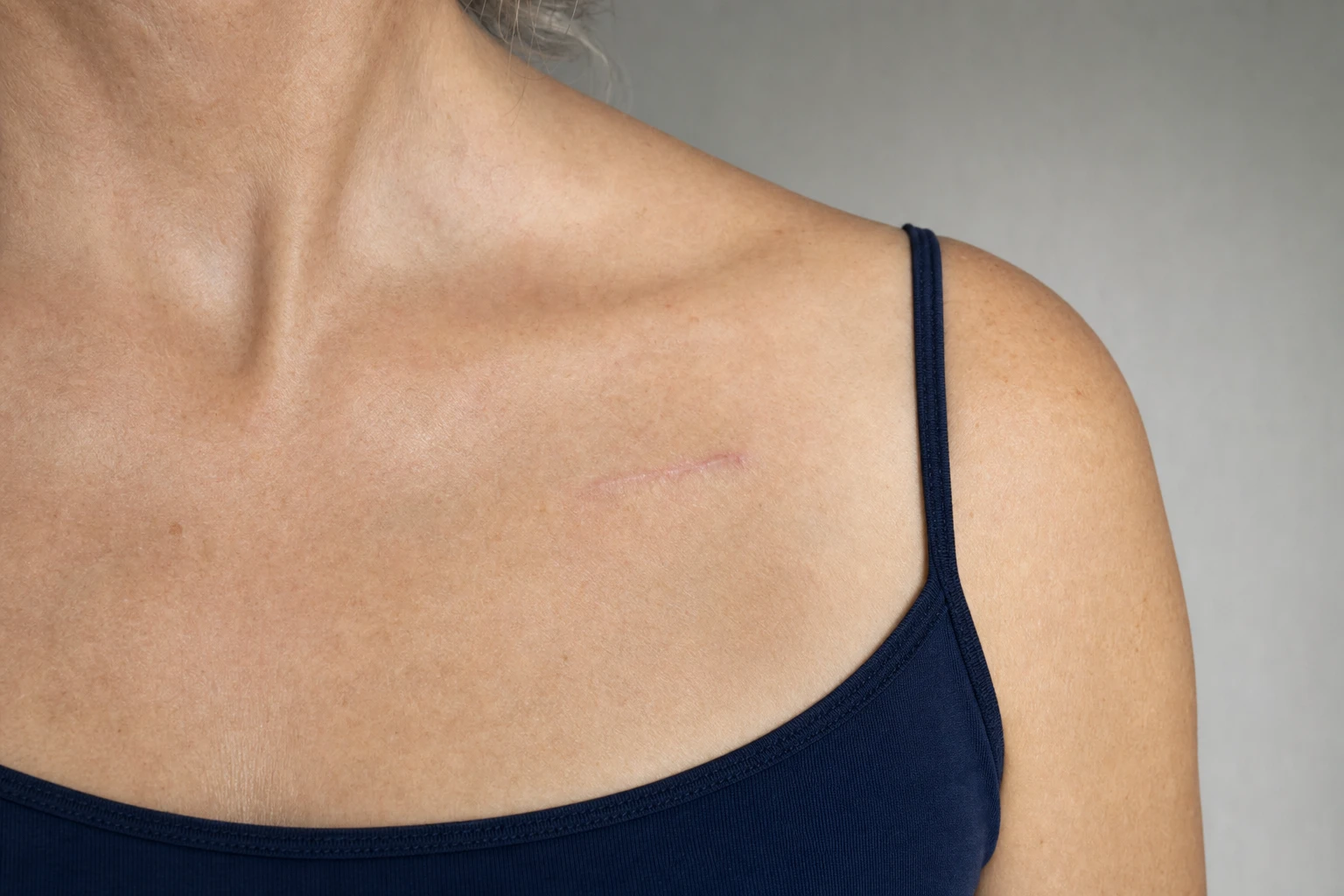
In Brief
Five things to know before deciding- What it is: a thick, firm raised area where the skin was injured, caused by excess collagen during healing; it stays within the boundaries of the wound.
- How it changes: the scar can flatten and fade over time, sometimes over several years; it can itch, hurt or interfere with movement.
- Options: silicone gel or sheets, pressure, massage, injection into the scar, applying cold and fractional laser treatment; each has its limitations, and none guarantees that the scar will disappear or that it will not come back.
- Prevention: no measure guarantees that a thick scar will not form; a wound under tension is more at risk.
- When to have it examined: a scar that keeps growing, bleeds, opens, is very painful or changes in appearance requires medical advice right away.
What Is a Hypertrophic Scar, and How Is It Identified?
When the skin is injured by a cut, surgery or a burn, it repairs itself by producing collagen, the protein that strengthens it. In a hypertrophic scar, the repair cells multiply and produce too much of it: the scar becomes thick, firm and raised, and it stays within the boundaries of the original wound. Depending on where it is, it can be uncomfortable or limit movement.
The doctor identifies it during an examination, based on the history of the injury and the appearance of the scar. If there is still doubt, the doctor may take a small piece of skin for analysis. A photo is not enough to tell what type of scar it is. If a raised area has appeared without any known injury, have it examined to identify the cause.
Hypertrophic or Keloid: What Sets Them Apart
Both are raised scars, and they are often confused. A hypertrophic scar stays within the boundaries of the injury and can flatten over time; a keloid can extend beyond these boundaries. A raised area that extends beyond the injury may be a keloid scar: this difference guides the choice of treatment. On examination, the doctor can identify the type of scar before a treatment is chosen.
Causes of a Hypertrophic Scar: Tension, Location and Predisposition
It forms after an injury to the skin: surgery, a wound, a burn. The direct cause is the excess collagen produced during repair; what causes the skin to produce so much of it depends on the injury, the location and the person.
A wound that is stretched while it heals is more likely to leave a thick scar. During the examination, describe where the injury was, which movements pull on this area and how the wound healed.
A family predisposition is well described for keloids; for hypertrophic scars, no genetic predisposition has been demonstrated. The injury and the tension on the wound play a role in how it forms.
How Long Does a Hypertrophic Scar Keep Changing?
A hypertrophic scar does not stay the same. Over time, it can flatten and fade, which sometimes takes several years. This process does not happen at the same pace for everyone. Three aspects should be considered separately: the time it takes for the scar to mature on its own, how long a treatment lasts, and whether a scar persists or comes back despite treatment.
Pain, Itching and Restricted Movement: What They Mean
A hypertrophic scar can itch, hurt or limit movement, depending on where it is. These symptoms are taken into account as much as the scar's appearance when choosing treatment, and should be mentioned during the assessment: note when they occur and what makes them worse. However, very severe pain requires medical advice right away, especially if a common painkiller does not relieve it.
Treatments for Hypertrophic Scars
The treatment of a scar depends first on its type: an indented acne scar is not treated like a raised scar, and acne scars are assessed based on their shape and depth. For a hypertrophic scar, the general options are silicone, pressure, massage, injection into the scar, applying cold and fractional laser treatment. Each has its limitations, none guarantees that the scar will disappear, and the doctor chooses based on the goal, how raised the scar is, how long it has been there, its location, your skin tone, the symptoms, the treatments already tried and how well you tolerate treatment. These options are described in general terms: if one of them is appropriate for you but is not offered at CARE MD, the doctor will refer you.
Silicone Gel or Sheets
Silicone is applied to the skin as a gel or a sheet. The goal is to reduce how raised the scar is and improve its flexibility or colour, although these changes cannot be predicted in advance. The benefits for flexibility and colour remain uncertain, and it is also uncertain whether sheets work better than most other treatments. Gel and sheets are two different forms: a result obtained with a sheet is not guaranteed with a gel. The purpose of the assessment is to choose an option that is appropriate for your skin, not to predict its result.
After a burn, gels, with or without silicone, can form a covering that holds in moisture and limits water loss. However, this covering does not guarantee that the scar will flatten. A moisturizer can help keep the skin hydrated; hydration should not be confused with treating the raised area.
Silicone must only be applied to skin that has healed over, never to an open wound. Stop using it if a rash appears. After a burn, gels can also cause irritation, itching or maceration, especially in hot weather. Before you start, ask for instructions on which form to use, how long to apply it and which skin changes to report.
Pressure
Pressure therapy uses tight elastic garments worn over the scar once the wound is considered to have healed enough. After a burn, its benefits and risks remain very uncertain compared with other treatments. As a result, flattening cannot be promised, and no single duration of wear can be specified for all scars.
Wearing a tight garment must fit into your daily routine. Before choosing this option, ask how to check that the garment fits properly, how long you would wear it and what to do if you find it hard to tolerate or if your skin becomes irritated. The doctor checks how well you tolerate it during follow-up; no universal schedule is given here.
Massage and So-Called Natural Treatments
After a burn, massage can provide short-term improvement, but it has not been established that it changes the scar in a lasting way. This immediate relief is therefore not proof that the raised area is disappearing.
After a burn, avoid firm massage early in healing, on an inflamed scar or on a scar that reopens. For a scar that has healed over, ask whether massage is appropriate, which technique to use and when to stop. Creams, oils and so-called natural treatments do not guarantee that the raised area will disappear either: “natural” does not mean effective or free of irritation. Hydrating the skin and treating a thick scar are two separate goals.
Injection Into the Scar
An injection into the scar delivers a prescribed treatment directly into the raised area. The goal is to make the scar less noticeable and reduce its symptoms, without promising that it will flatten completely. It can be combined with silicone. It is performed by a physician, or a nurse injector supervised by a physician, after an assessment.
At the injection site, bleeding, bruising, infection or delayed healing are possible. Later, the skin can become thinner or lighter, or small blood vessels can become visible. Changes in the raised area and in itching are monitored through reassessments, without predicting an individual outcome.
Before choosing this option, ask how pain during the procedure would be managed, whether another injection might be needed and which changes would lead to a decision to continue or stop. The number of sessions and the time between them still need to be clarified for your situation; no standard interval is given.
Cryotherapy: Applying Cold to the Scar
Cryotherapy uses cold to freeze a skin lesion. Cold does not guarantee that a hypertrophic scar will flatten. Before considering it, ask what could be improved in your case and why this option would be preferable to another.
The skin can react as it would after a burn: redness, swelling or blisters, followed by a scab. Its colour can become lighter or darker, especially on brown or black skin; this change often improves over time, but it can persist.
The size of the raised area and your skin tone are among the points to discuss before choosing cryotherapy. Also ask what pain to expect, how it would be relieved, how many sessions might be considered and what care to expect while the skin heals. There is no set healing time or number of sessions that applies to all scars.
Fractional CO2 Laser Treatment
Ablative fractional laser treatment uses heat to create tiny treatment zones that reach below the surface and stimulate collagen remodelling. The fractional CO2 laser works this way: it treats small columns of skin. The goal is to improve the scar, although it cannot be promised that laser treatment alone will make it less raised. Improvement in flexibility or symptoms is not certain, and no laser guarantees that the scar will disappear. The examination is used to determine whether this option is appropriate for your scar.
It is a medical procedure, performed by a physician, or a nurse supervised by a physician. Before laser treatment on a scar, the doctor takes into account your skin type, the characteristics of the scar and your general health; having fair skin is not enough to say that laser treatment is appropriate. A tan or a recent sunburn increases the risk of burns and changes in skin colour.
Before committing, ask how many sessions might be needed, what recovery would be like and what to apply to the skin at home. Ask for an explanation of the expected reactions, including redness or swelling, and of those that would justify calling the professional. No recovery timeline is given that applies to all scars.
After the session, protect the treated skin from the sun until it has healed: sun exposure can cause a new scar. The risks include changes in colour, burns and a new scar. Skin that is warm to the touch, very severe pain, persistent bleeding or a wound that opens requires medical advice right away. When it comes to planning your recovery days, what to expect after facial laser treatment matters as much as the goal of the treatment when making your choice.
Choosing a Treatment, and Reassessing When the Scar Persists
No option is the best for everyone. The scar can also flatten over time; an improvement after a treatment is therefore not necessarily due to the treatment alone.
If the scar persists or comes back, an examination is an opportunity to review the goal and how the scar has responded to the treatments already tried. Other prescribed treatments can be injected into the scar, alone or in combination; this does not mean they are better suited to every case. Before combining treatments or making a change, ask about the intended benefit, the risks specific to each product, the pain of the procedure and the follow-up. The risks of one injection do not automatically carry over to another. Waiting and watching how the scar changes can also be discussed. No treatment guarantees complete flattening or that the scar will not come back.
How Can You Reduce the Risk After an Injury?
No measure guarantees that a hypertrophic scar will not form, but a few guidelines help. Tension on a healing wound makes the scar thicker. A wound that opens or a scar that is warm to the touch should be examined right away, and nothing should be applied to an open wound without advice from a healthcare professional. Silicone can be considered once the skin has healed over. If you have had a thick scar before, mention it before a procedure (surgery, piercing, tattoo) so that the professional can take it into account.
When to See a Doctor About a Raised Scar
Itching or difficulty moving can accompany a hypertrophic scar; mention these during a non-urgent assessment.
Seek care right away
If the scar keeps growing, bleeds, opens, is very painful or changes in appearance, if it is warm to the touch, or if the raised area appeared without any known injury, so that its cause can be identified. Severe pain that a common painkiller does not relieve, or bleeding that does not stop when you apply pressure, calls for the same response. In these cases, see a doctor rather than waiting for a reply to a message.
What to Prepare for the Assessment
Note the date and cause of the injury, how the scar has changed, your symptoms (itching, pain, difficulty moving), any history of thick scars and the treatments you have already tried. During the Global Aesthetic consultation at CARE MD in Sainte-Thérèse, the doctor examines the scar, identifies its type, then discusses your goals, the options, their risks and follow-up with you; if another professional is better placed to treat your scar, the doctor will direct you to them. A message or a photo is no substitute for this in-person examination.
Ask Us About Your Raised Scar
Frequently asked questions
How long does it take for a hypertrophic scar to flatten?
A hypertrophic scar can flatten and fade over time, which sometimes takes several years. This process does not happen at the same pace for everyone. The time it takes for the scar to mature on its own, how long a treatment lasts and whether the scar persists or comes back are three separate things; medical follow-up makes it possible to see how it is changing.
Sources1 reference
Does a hypertrophic scar hurt or itch?
It can itch, hurt or limit movement, depending on where it is. These symptoms are taken into account when choosing treatment, and should be mentioned during the assessment. Very severe pain that a common painkiller does not relieve, or a scar that bleeds, opens or becomes warm to the touch, is not ordinary discomfort: see a doctor right away.
Sources3 references
Can a hypertrophic scar come back or persist after treatment?
No treatment guarantees that the scar will flatten completely or that it will not come back. The scar can also flatten over time; an improvement after a treatment is therefore not necessarily due to the treatment alone. When the scar persists or comes back, the doctor reassesses it and may consider changing treatment, combining several treatments or waiting; the doctor makes this choice, and each added treatment carries its own risks.
Sources2 references
When should you have a raised scar examined?
Right away if it keeps growing, bleeds, opens, is very painful, changes in appearance or becomes warm to the touch, and if the raised area appeared without an injury. These are signs that require a doctor's attention; they are not ordinary discomfort. Itching or difficulty moving can accompany a hypertrophic scar; mention these during a non-urgent assessment.
Sources4 references
Is a raised area after a C-section, piercing or tattoo a hypertrophic scar?
The context of the injury is not enough to tell what type of scar it is: a raised area after a C-section, an ear or nose piercing, or a tattoo can be a hypertrophic scar, a keloid or something else, and only the doctor can determine this on examination. Note how long the raised area has been there, whether it is getting bigger, and whether it itches, hurts or interferes with movement. If it grows, bleeds or opens, seek care right away.
Sources2 references
What role does genetics play in hypertrophic scars?
A family predisposition is well described for keloids; for hypertrophic scars, no genetic predisposition has been demonstrated. The injury and the tension on the healing wound play a role in how it forms. If you have had a thick scar before, mention it before a procedure (surgery, piercing, tattoo).
Sources2 references
How can you reduce the risk of a hypertrophic scar after an injury?
No measure guarantees that a hypertrophic scar will not form. Tension on a healing wound makes the scar thicker. Silicone can be considered once the skin has healed over, never on an open wound, and nothing should be applied to an open wound without advice from a healthcare professional. If you have had a thick scar before, mention it before a procedure.
Sources2 references
What is a hypertrophic scar, and how is it identified?
It is a thick, firm, raised scar formed by excess collagen while the skin repairs itself. It stays within the boundaries of the injury. The doctor identifies it based on the history of the wound and an examination; a skin sample may be needed if any doubt remains. A photo is no substitute for this examination. A raised area that appeared without any known injury must be examined to identify its cause.
Sources3 references
What treatments can be considered for a hypertrophic scar, and what are the risks?
The general options include silicone gel or sheets, pressure, massage, injection into the scar, applying cold and fractional laser treatment. Silicone must not be applied to an open wound. Whether sheets work better than most other treatments remains uncertain; after a burn, the benefits of pressure therapy and the lasting effects of massage remain uncertain. An injection can cause bleeding, bruising, infection, delayed healing, thinning of the skin or lighter patches. Cold can leave a lasting change in colour; laser treatment can burn the skin or leave a new scar. How these treatments work does not guarantee a benefit for the raised area. The choice depends on the scar, your skin and how well you tolerate treatment. Ask about the number of sessions that might be involved, pain management and care during healing. No treatment guarantees that the scar will disappear or that it will not come back. These options are not presented as available at CARE MD: the Global Aesthetic consultation is an opportunity to have your scar examined and to receive guidance.
Sources10 references+
- DermNet — Keloid and hypertrophic scar (opens in a new tab)
- PubMed Central — Current Advances in Hypertrophic Scar and Keloid Management (opens in a new tab)
- NHS — Scars (opens in a new tab)
- Cochrane — Silicone gel sheeting for treating hypertrophic scars (opens in a new tab)
- Imperial College Healthcare NHS — How can I look after my scar? (opens in a new tab)
- PubMed Central — Evidence Supporting Conservative Scar Management Interventions Following Burn Injury: A Review Article (opens in a new tab)
- Cochrane — Pressure garments for preventing hypertrophic scarring after burn injury (opens in a new tab)
- British Association of Dermatologists — Cryotherapy (opens in a new tab)
- Study of fractional laser treatment for burn scars (Lasers in Medical Science) (opens in a new tab)
- American Academy of Dermatology — 10 things to know before having laser treatment for your scar (opens in a new tab)
Raised Scars: Limitations and Precautions
Before choosing a treatment, go over the risks for your skin with the doctor; at CARE MD, the Global Aesthetic consultation is an opportunity for this examination.
Limitations and precautions
Wait until the wound has closed before applying silicone; stop using it if a rash appears.
After a burn, do not massage a scar vigorously if it is still in the early stages of healing, is inflamed or is reopening.
Before laser treatment, avoid tanning and sunburn; afterwards, keep the area out of the sun until it has healed.
Before treatment, mention your skin tone, any treatments you have already tried and any thick scars you have had before.
Do not wait to see a doctor if your scar keeps growing, bleeds, opens, becomes very painful or warm, or changes in appearance. If a raised area has appeared without a known injury, also have its cause checked.
You cannot count on the scar disappearing or not coming back; even with cold or laser treatment, whether it will flatten remains uncertain.
Silicone sheets are not clearly better than most other treatments. After a burn, the benefits and risks of pressure therapy remain very uncertain; it has not been established that massage has a lasting effect.
With an injection, your skin can become thinner, become lighter in places or show small blood vessels. Cold can cause a lasting change in its colour, especially if it is brown or black; laser treatment can also change its colour, burn it or cause another scar.
For your scar to be identified, you need to be examined in person: neither a photo nor a message is enough.
