


Key Points
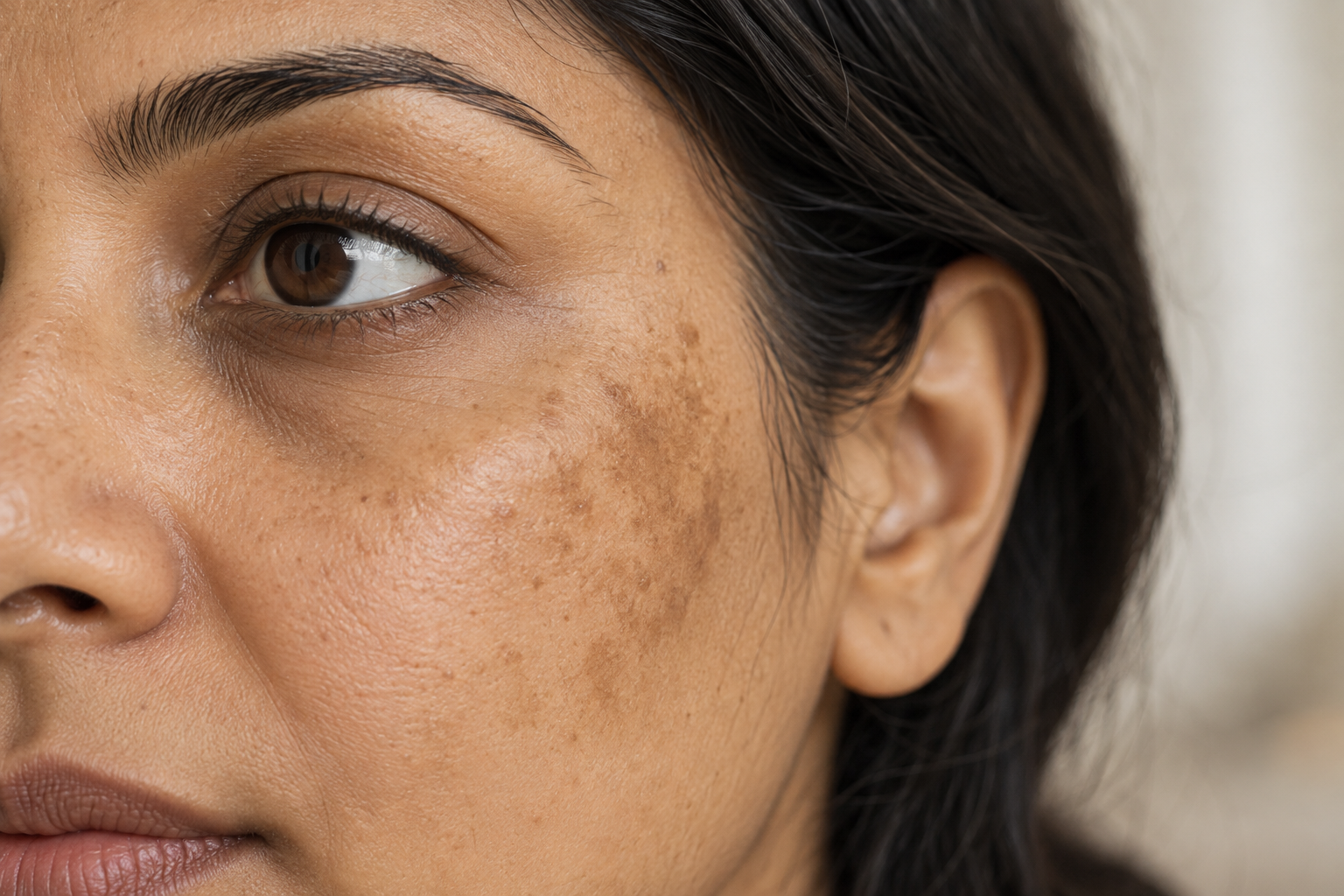
Melasma appears as darker patches, often on the face. Its causes are not fully understood: sunlight, hormonal influences and a family predisposition may play a role. You can have melasma without being pregnant. The following information distinguishes recognized factors from associations still being studied.
- Pregnancy can contribute to melasma. Hormonal changes are among the possible explanations, along with sun exposure. However, patches do not appear during every pregnancy.
- The role of hormones is not limited to progesterone. Researchers are examining estrogen and progesterone receptors in affected skin, without identifying any one hormone as the sole cause.
- UV rays are not the only form of radiation involved. Visible light from the sun can also contribute to pigmentation. Tinted sunscreen containing iron oxides complements UV protection.
- Family history is among the associated factors. Having an affected relative does not mean that melasma will necessarily develop or follow the same course.
- Irritated skin can develop dark patches. Products that sting or burn can worsen pigmentation; gentle skin care limits this irritation. A patch that appears after irritation is not necessarily melasma.
- Heat is being studied. One study observed an association between certain types of heat exposure and the severity of melasma; it does not show that heat alone causes it.
- Hormonal contraception may be a trigger for some people. This possibility does not mean that all dark patches can be attributed to contraception or that it is possible to predict who will be affected.
- Thyroid disorders have been associated with melasma. This link does not mean that someone with dark patches necessarily has thyroid disease.
To prepare for a consultation, you can note when the patches appeared and any changes in medication or skin care that preceded them. These observations provide context; they do not replace a skin examination.
Introduction
Melasma is acquired skin pigmentation, often appearing symmetrically on the face. The name “mask of pregnancy” describes one possible context, but does not cover every situation. Several factors may act together, without a single cause explaining every case.
A medical assessment helps distinguish melasma from other causes of brown patches. The appearance of the skin guides the diagnosis; dermatological tools can help assess the depth of the pigment. This distinction comes before the choice of skin care or treatment.
If you are looking for what triggered the patches, their appearance does not always point to a single cause. Sun exposure and hormonal factors are recognized possibilities; the mechanisms remain partly unclear.
Hormonal Causes of Melasma
Pregnancy and Hormonal Changes
Pregnancy is one of the circumstances in which melasma can appear. Hormones feature in the hypotheses explaining this association, while sunlight can worsen pigmentation. Skin studies are exploring hormonal receptors in particular, but cannot predict who will develop patches.
Oral Contraception
Melasma can develop while taking hormonal contraception, although this does not happen to everyone who uses it. The appearance of patches warrants a discussion with the prescribing health professional. Contraception should not be stopped or changed without their advice.
Impact of Oophorectomy
Removing both ovaries before menopause causes surgical menopause; hormone therapy may then be considered depending on the situation. Some hormone therapies can contribute to melasma. This does not mean that patches can be attributed directly to the operation: the medical context and medications must be examined separately.
Sun Exposure and the Light Spectrum
Influence of UV Radiation
Sunlight contributes to the onset and worsening of melasma. The term “broad spectrum” on sunscreen refers to protection against UVA and UVB rays. On its own, it does not mean that the product also protects against visible light. Tinted sunscreens containing iron oxides address this additional concern.
Visible and Infrared Light
Visible light from the sun can contribute to pigmentation, in addition to UV rays. Research on sun protection has examined the value of adding protection against visible light. This finding should not be extended to all light sources: exposure to personal screens is not equivalent to sun exposure.
Melanin Accumulation
Sun exposure can cause melasma patches to reappear or darken. Their course varies: they may fade in some situations and persist in others. Sun protection therefore remains important over time, without guaranteeing that the pigment will disappear or preventing every recurrence.
Genetic Predispositions and Phototypes
Heredity
Melasma is more common when other family members are affected. This observation supports a predisposition, but does not describe a simple pattern of inheritance from parent to child. A family history cannot predict the age of onset, intensity or course of the patches.
Susceptible Phototypes
Melasma frequently affects people with medium to dark skin tones. A study conducted at several centres in India found that intermediate skin phototypes made up the majority of those affected. This observation does not mean that everyone with this phototype will develop melasma or that all other skin types are unaffected.
Prevalence in Women
Women are affected more often, but men can also develop melasma. This difference appears in clinical studies and is not enough, on its own, to explain all the mechanisms involved. In men as well, facial patches need to be identified before they are treated.
Photosensitizing Medications
Commonly Involved Medications
Some medications can contribute to pigmentation or make the skin more sensitive to the sun. Hormone therapies are also among the possible factors in melasma. The link depends on the product and the context: a list of medication classes is not enough to determine the cause of someone's patches.
Phototoxicity and Medications
A skin reaction to sunlight while taking medication is not enough to establish a diagnosis of melasma. If there is doubt, the prescriber can check whether pigmentation or sun sensitivity is among the product's possible effects. Treatment should not be stopped without this advice.
Skin Inflammation and Trauma
Microtrauma
Irritating skin care products can contribute to dark patches or worsen existing pigmentation. More intensive cleansing is therefore not necessarily helpful for the skin: a product that causes burning or stinging may be poorly tolerated. Gentle, fragrance-free products are preferable.
Hair Removal and Other Procedures
A skin injury or burn can leave a pigmented mark after it heals. When a procedure irritates the skin, this possibility must be distinguished from melasma. The choice of a hair removal method therefore cannot be based solely on the colour of the patches: their cause must first be clarified.
Post-inflammatory Hyperpigmentation
Post-inflammatory hyperpigmentation refers to marks that can follow skin inflammation or injury, for example after a pimple or a burn. Its origin differs from that of melasma. An examination helps identify the condition; the presence of brown patches alone is not enough to treat the two as the same.
Environmental and Physiological Aggravating Factors
Heat and Stress
A study conducted at several centres in India found a link between the duration of exposure to cooking or occupational heat and the severity of melasma. Because it observed people who already had the condition, it does not prove that heat alone triggers it or that avoiding all heat exposure would treat melasma.
Effects of Psychological Stress
The role of stress in the onset of melasma remains debated. This should not be taken to mean that the patches reflect poor management of emotions. Melasma can nevertheless affect well-being; this experience deserves to be heard, without presenting relaxation as a proven treatment for pigmentation.
Sweating
Sweating alone does not explain the onset of melasma. In practice, it matters mainly for sunscreen use: sunscreen must be reapplied after heavy sweating. The label “water resistant” does not remove the need for this reapplication.
Biological Mechanisms
Melanin Production
Melanin is the pigment that contributes to skin colour. In melasma biopsies, researchers have observed more pigment and more active pigment-producing cells, without necessarily finding more of these cells. These observations describe how the skin functions; they do not guarantee the outcome of a treatment.
Melanin Distribution
Pigment can be observed in the epidermis, the outer layer of the skin, and in the deeper dermis. Its distribution provides useful information during the assessment. It does not mean that laser treatment is necessary: these procedures can also worsen pigmentation and require an individual assessment.
Melanocyte Cascade
Pigment production depends on several signals within the skin. Studies of estrogen and progesterone receptors help explore the role of hormones, but their findings do not describe a single cause. An observation under a microscope is not enough to determine the appropriate treatment or predict recurrences.
The biological mechanisms remain complex, but daily care can remain simple: protecting the skin from the sun and choosing skin care products that cause little irritation. These measures support care; they are not a promise of a cure or a way to control every contributing factor.
Conclusion
Understanding the factors associated with melasma helps avoid overly simple explanations: a possible factor is not a definite cause in every person. You can prepare questions about medications, skin care products and changes in the patches. The virtual consultation offered here is an initial discussion; it does not replace the in-person assessment that comes before choosing a treatment.

Ask us your questions about this treatment
Sources10 references+
- Melasma: Causes — sun, hormonal and family factors in melasma (opens in a new tab)
- Melasma: Self-care — tolerated skin care and protection against sunlight and visible light (opens in a new tab)
- Melasma: Diagnosis and treatment — diagnosis, basic care and procedure risks (opens in a new tab)
- Melasma — course, recurrence and limitations of melasma options (opens in a new tab)
- Light microscopic, immunohistochemical, and ultrastructural alterations in patients with melasma. — microscopic pigment observations in melasma biopsies (opens in a new tab)
- Oestrogen and progesterone receptor expression in melasma: an immunohistochemical analysis — observations of hormone receptors in affected skin (opens in a new tab)
- Considerations - Hysterectomy — ovary removal and surgical menopause, without establishing a direct cause of melasma (opens in a new tab)
- How to fade dark spots in darker skin tones — causes of dark spots, fading times and precautions (opens in a new tab)
- Clinical and epidemiologic features of melasma: a multicentric cross-sectional study from India — skin type and heat associations, without establishing causality (opens in a new tab)
- Near-visible light and UV photoprotection in the treatment of melasma: a double-blind randomized trial — trial of UV and visible-light protection alongside treatment (opens in a new tab)
Medical information
Facial pigmentation is not enough to establish a diagnosis of melasma. A medical examination helps distinguish the possible causes. Medication or contraception should not be stopped without advice from the prescriber. Irritating skin care products can worsen the patches.
