


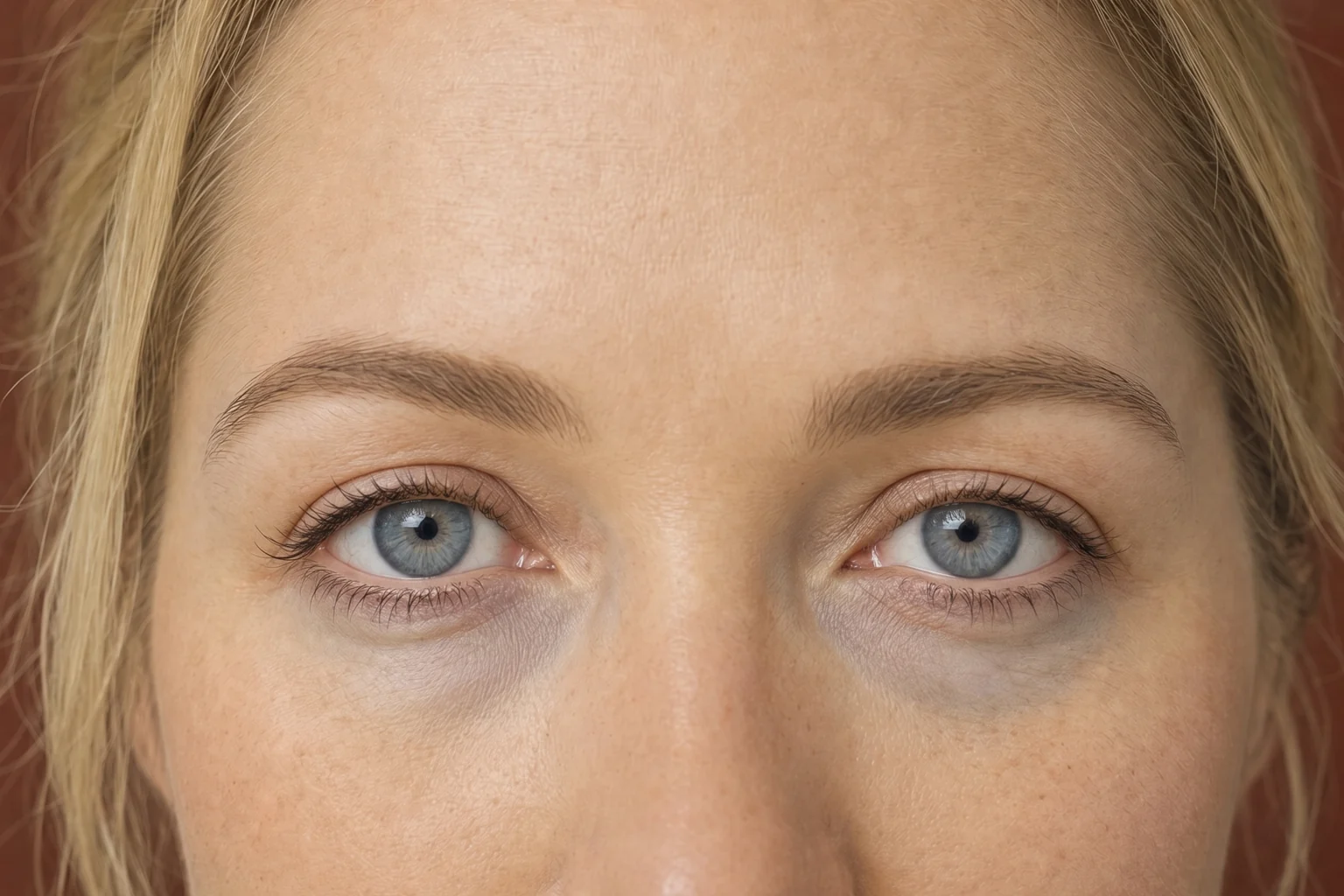
The Tyndall Effect Under the Eyes: Causes, Prevention and Correction
A few days after a hyaluronic acid injection under your eyes, you notice a bluish shadow in the mirror that does not go away, sometimes with a slight bump. Or you are considering this injection for your under-eye circles and have read that it can leave a blue tint.
In aesthetic medicine, this tint has a name: the Tyndall effect. It comes from hyaluronic acid gel placed too close to the surface, which happens more easily where the skin is thin, such as under the eyes. The risk can be reduced before the injection, and discolouration that has already developed can be corrected. Unusual pain, a change in vision or skin that turns white, grey or blue near the injection site can signal a blood vessel complication and require immediate care.
In Brief
Five things to know before deciding- What it is: a bluish tint visible in the skin after a hyaluronic acid injection, when the gel has been placed too close to the surface; under the eyes, it appears as a bluish shadow where the injection was given.
- Why: gel placed too superficially or deposited in a large amount in one spot, under thin skin; the explanation based on light is debated, and appearance alone is not enough to make a diagnosis.
- Prevention: an assessment of the skin and a technique that avoids placing the gel too superficially; these reduce the risk without eliminating it.
- If it appears: have it assessed by the person who injected you; you can also ask your questions during a Global Aesthetic consultation at CARE MD; a prescription treatment that dissolves the gel can correct it, although neither the timing nor the result is guaranteed.
- Right away: unusual pain, a change in vision, skin that turns white, grey or blue near the injection site, or signs of infection require immediate care.
What Is the Tyndall Effect in Aesthetic Medicine?
The term refers to the bluish tint visible in the skin when a hyaluronic acid gel, a type of filler, has been placed too close to the surface. The name describes what you see; it is not a diagnosis. An in-person assessment is needed to confirm the cause of the discolouration.
In the context of under-eye circles, the Tyndall effect takes the form of a bluish shadow under the eye, where the gel was injected; this is also where this discolouration is most typically seen.
The name comes from physics, where it refers to the scattering of light by certain particles; here, the Tyndall effect refers to skin discolouration after an injection, not the sign observed during an eye examination.
Why Does It Appear After an Under-Eye Injection?
It all comes down to where the gel is located. When it is placed too close to the surface, or deposited in a large amount in one spot, the skin covering it takes on a bluish tint. This placement depends on the technique, and the skin matters too: discolouration is more likely where the skin is thin, such as under the eyes.
Why blue? The traditional explanation involves light: depending on its colour, light scatters to different degrees when it encounters small particles, and blue is thought to be the colour mainly seen. This explanation is debated. Injected gel is a complex material that these scattering models do not describe well. This physical phenomenon is unlikely to explain, on its own, the tint of the skin.
Another possible explanation is anatomical: the composition of the tissues under the skin may contribute to the tint seen in the same place in some people. This hypothesis cannot explain your discolouration based on its appearance. To decide on the next steps, the assessment includes checking, among other things, where the gel is located.
What Does It Look Like, and How Can You Tell It Apart From a Bruise or an Under-Eye Bag?
The tint is bluish and visible in the skin where the gel was placed. The area often has a slight bump or small irregularities, because the gel is close to the surface. The discolouration may be visible as soon as the injection is finished or appear only after a few days; without correction, it can last for months or even years.
It can look like a faint but deep bruise, which can be confusing in the days following the injection. Most hyaluronic acid filler side effects, such as swelling and bruising, occur shortly after the injection, and many go away within a few days to a few weeks. A bag or swelling under the eyes after a hyaluronic acid injection is therefore not, in itself, the Tyndall effect: it is a different change, which needs to be assessed in its own right. Some effects also appear later: weeks, months or even years after the injection.
A bluish under-eye circle that you already had before the injection is not the Tyndall effect either, since the Tyndall effect comes from the gel; in that case, dark circle treatment starts with what gives the circle its colour or its hollow appearance.
None of these signs is enough to make a diagnosis: appearance alone does not distinguish discolouration caused by the gel from another complication. When the tint appeared, how it has changed and the symptoms that accompany it guide the assessment.
How Often Is It Seen?
The Tyndall effect is a known complication of hyaluronic acid injections under the eyes, which occurs only in some people. A percentage observed for a product or technique cannot predict your own risk. The risk varies with what happens at the time of the injection: the depth at which the gel is placed, the amount deposited in one spot and how thin the skin is.
Before the injection, ask what may increase the risk in your case and which precautions are appropriate for your skin.
How Can You Reduce the Risk Before an Under-Eye Injection?
If you are considering a hyaluronic acid injection under the eyes, prevention begins before the injection. The first step in the assessment is to check whether a gel addresses what you want to change; the assessment may show that another approach suits you better. The thickness of your skin is also assessed, and the injection plan is adapted to what the examination shows.
Next comes technique, the primary way to prevent this discolouration. The principle is not to place the gel too close to the surface, nor to deposit a large amount in one spot. The person performing the injection decides on the depth, the amount and how to distribute the gel, based on your anatomy.
That is why the choice of this person matters. Choose a healthcare professional who is experienced with these injections, and before you decide, ask them which risks apply to your situation, what would happen if discolouration appeared and how it would be corrected. A careful assessment and meticulous technique reduce the risk; they do not eliminate it.
What Should You Do If Discolouration Appears?
After a hyaluronic acid injection for under-eye circles, a bluish shadow quickly makes you think that the injection has gone wrong. Yet what you see can have several causes: a bluish tint caused by the gel, a bruise and swelling do not have the same cause or the same course. The first step is therefore to have the discolouration assessed, without assuming what caused it.
When the doctor concludes during the assessment that hyaluronic acid gel has been placed too superficially, correction is possible: a prescription treatment that dissolves the gel. Its aim is to break down the overly superficial gel in that area so that the tint fades. This treatment is injected by a doctor, or by a nurse injector supervised by a doctor.
A decision is first made with you: whether to dissolve all of the gel, or only the part that is discolouring the skin. If the gel had been placed for under-eye hollows, dissolving it can mean losing some of the volume achieved, and the original hollow can become visible again.
Waiting is another possibility, once a blood vessel complication or an infection has been ruled out. Some fillers break down over time, but that rate does not tell you when the tint will go away: without correction, it can last for months or even years. The decision to wait is therefore made with the person assessing you, with this uncertainty in mind.
Certain laser treatments have also been tried to fade this discolouration, but they are not an established solution.
- Result
-
Improvement can be quick, but a second session is sometimes needed; neither the timing nor the result is guaranteed.
- Risk
-
This treatment can cause an allergic reaction. Such reactions are uncommon in aesthetic medicine, and your allergies are discussed beforehand.
- Follow-up
-
The doctor then checks the tint to make sure it is fading; if the correction is not enough, referral to a professional with more experience managing these complications may be needed.
Who Assesses the Discolouration, and What Happens During the Consultation?
Discolouration under the eyes needs to be assessed in person: neither a photo nor the mirror is enough to establish its cause. You can ask your questions about this discolouration during a Global Aesthetic consultation at CARE MD in Sainte-Thérèse. During the assessment, the doctor determines what needs to be examined and whether a referral is needed. You can also learn about CARE MD's professionals before your appointment.
To make the discussion useful, prepare the following information:
- what led you to have the injection in the first place: hollowing, discolouration or both;
- the date of the injection, what has changed since then and, if you know it, the type of product injected;
- your previous aesthetic treatments, including other injections or implants;
- your health problems and allergies;
- all your medications, including those sold without a prescription, as well as your vitamins, minerals and natural products.
The assessment does not necessarily lead to a correction. The doctor may conclude that a prescription treatment that dissolves the gel can be considered, that it is better to monitor the tint, that another approach is more appropriate, or that a professional with more experience in these complications should take over. Inflamed or infected skin also means that any new filler injection is postponed until the skin has been treated.
Seek Care Right Away
During or after an injection near the eye, including in the following days, these signs are not simply discolouration:
- unusual pain;
- a change in vision;
- skin that turns white, grey or blue near the injection site;
- signs of infection: an area that is red, swollen, painful and warm, sometimes with fever.
Seek care right away
These signs require immediate medical care. Call the person who performed the injection or go to the emergency department, instead of using a form.
A stable bluish tint that does not hurt does not look the same as skin that turns white, grey or blue near the injection site, even without pain: the latter can signal a blood vessel blocked by the gel. You do not have to sort this out yourself. If you are at all unsure, seek immediate care.
Ask Us About the Tyndall Effect
Do you have a question about discolouration that appeared after an under-eye injection, or about what you should know before having one? Write to us. Your message is no substitute for medical care: unusual pain, a change in vision, white, grey or blue skin near the injection site, or signs of infection require immediate medical care.
Frequently Asked Questions
What is the Tyndall effect?
In aesthetic medicine, the Tyndall effect is a bluish tint visible in the skin after a hyaluronic acid injection, when the gel has been placed too close to the surface. It is typically seen under the eyes, where it can look like a bruise, often with a slight bump. The name describes an appearance: the cause of discolouration is confirmed during an in-person assessment.
Sources2 references
What is the Tyndall effect under the eyes?
Under the eyes, the Tyndall effect causes a bluish shadow where the hyaluronic acid gel was injected, sometimes with a slight bump. It appears when the gel is too close to the surface, and the risk is greater where the skin is thin. The tint may be visible right after the injection or a few days later and, without correction, can last for months or even years. A prescription treatment that dissolves the gel can fade it, after an assessment.
Sources4 references
How can the Tyndall effect be prevented?
Through appropriate assessment and technique. Before the injection, the person performing it checks whether a gel addresses what you want to change and takes the thickness of your skin into account. During the injection, the gel must not be placed too close to the surface or in a large amount in one spot. Choose a professional experienced with under-eye injections: these precautions reduce the risk without eliminating it.
Sources3 references
What should you do if the Tyndall effect appears?
First, have the discolouration assessed, without assuming what caused it. If it comes from hyaluronic acid gel placed too superficially, a prescription treatment that dissolves the gel can correct it; a second session is sometimes needed and the result is not guaranteed. Waiting is possible once a complication has been ruled out, but the tint can last for months. Unusual pain, a change in vision, skin that turns white, grey or blue near the injection site, or signs of infection require immediate care.
Sources4 references
Does the Tyndall effect go away over time?
Not predictably. Some fillers gradually break down, but that rate does not tell you when the tint will go away: without correction, it can last for months or even years. The decision to wait is made with the person assessing you, once a blood vessel complication or an infection has been ruled out. If the tint bothers you, a prescription treatment that dissolves the gel is another possibility, with its own risk of allergic reaction.
Sources4 references
My under-eye filler seems to have gone wrong: what should I do?
Have what you are seeing examined before drawing conclusions. An under-eye filler injection that seems to have gone wrong can involve different situations: a bluish tint caused by gel that is too superficial, a bruise or swelling, which do not have the same cause or the same course. Many cases of swelling and bruising go away within a few days to a few weeks. Discolouration caused by the gel can be corrected with a prescription treatment that dissolves the gel, but the result is not guaranteed. Unusual pain, a change in vision or signs of infection require immediate care.
Sources4 references
Bags under the eyes after a hyaluronic acid injection: is this the Tyndall effect?
Not necessarily. The Tyndall effect is a bluish discolouration, sometimes with a slight bump; a bag or swelling is a different change. Swelling is one of the usual after-effects of a filler injection: it generally occurs soon after and often goes away within a few days to a few weeks, but some effects appear later. If a bag persists or changes, have it assessed, and seek immediate care if you have unusual pain, a red and warm area or a change in vision.
Sources3 references
Sources9 references+
- Management of Tyndall Effect — Journal of Clinical and Aesthetic Dermatology, 2016 (opens in a new tab)
- Management of injected hyaluronic acid induced Tyndall effects — Lasers in Surgery and Medicine, 2006 (PubMed abstract) (opens in a new tab)
- Does the Tyndall Effect Describe the Blue Hue Periodically Observed in Subdermal Hyaluronic Acid Gel Placement? — Ophthalmic Plastic and Reconstructive Surgery, 2014 (PubMed abstract) (opens in a new tab)
- Cross-Sectional Soft-Tissue Composition and the Distribution of Blue Cutaneous Discoloration in the Lower Eyelid after Hyaluronic Acid Injection — Plastic and Reconstructive Surgery, 2019 (PubMed abstract) (opens in a new tab)
- Management of dermal filler complications, a narrative review — JMIR Dermatology, 2024 (opens in a new tab)
- Dermal Fillers (Soft Tissue Fillers) — U.S. Food and Drug Administration (opens in a new tab)
- Guideline for the Prevention, Diagnosis, and Management of Acute Bacterial Soft Tissue Infections Following Nonsurgical Cosmetic Procedures — Journal of Clinical and Aesthetic Dermatology, 2021 (opens in a new tab)
- Fillers: Preparation — American Academy of Dermatology (opens in a new tab)
- Cosmetic injections — Health Canada (opens in a new tab)
Bluish Discolouration After an Under-Eye Injection: Limitations and Precautions
A bluish tint under the eyes after an injection needs to be examined in person to clarify its cause and the appropriate correction: appearance alone is not enough. You can discuss it with CARE MD.
Limitations and precautions
During or after an injection near the eye, get immediate medical care if you have unusual pain, a change in vision, white, grey or blue skin near the injection site or signs of infection. Do not wait for a reply to a message submitted through a form.
Disclose your allergies: a reaction to the treatment that dissolves the gel is possible, although it is uncommon in aesthetic medicine.
Mention your previous aesthetic treatments, health problems, medications, vitamins and natural products.
Postpone any new filler injection until skin inflammation or infection has been treated.
Keep in mind that the role of light scattering remains debated.
Percentages associated with a product or technique do not quantify your personal risk.
Even with a careful examination and meticulous technique, you still face some risk, although it is reduced.
If you receive a prescribed treatment to dissolve the gel, the result and the timing remain uncertain; you may need a second session and lose some of the volume achieved.
Without correction, this tint can last for months or even years.

Have a Bluish Tint Under Your Eyes Examined
If a bluish tint persists under your eyes after an injection, or if you want to understand this risk before having one, you can ask your questions during a Global Aesthetic consultation at CARE MD in Sainte-Thérèse, to clarify what needs to be assessed and whether a referral is needed.