


Laser for Dark Circles: What It Can Reduce and What It Does Not Fix
You notice a dark area under your eyes and wonder whether a laser can make it less noticeable. The answer depends on what causes the dark appearance under your eyes: brown pigment, blood vessels showing through thin skin, or a hollow that casts a shadow. A laser acts on a specific target, so laser treatment for dark circles helps in some cases and not in others. Under the eye, the thin skin also calls for caution. CARE MD, in Sainte-Thérèse, examines dark circles during a Global Aesthetic consultation; for this area, CARE MD's physician still needs to confirm the indications for CO2 laser and pulsed light before CARE MD offers them for dark circles. The decision therefore starts with identifying the cause of your dark circles, not with choosing a device.
- No laser fills a hollow
- Global Aesthetic consultation
- Sainte-Thérèse
In Brief
Five things to know before deciding- Three causes: a dark circle can be pigmented (brown), vascular (bluish to purplish) or hollow (the shadow of a lack of volume), and these causes often occur together.
- What a laser targets: pigment, blood vessels or skin texture; no laser fills a hollow.
- Under the eye: the skin is thin, and brown or Black skin is more prone to lasting changes in colour; this need for caution affects the decision.
- At CARE MD: during the Global Aesthetic consultation, the doctor examines your dark circles; for this area, the physician still needs to confirm the indications for CO2 laser and pulsed light.
- Other approaches: filler for a hollow, non-ablative resurfacing, which is less aggressive than ablative resurfacing and must be evaluated for the area concerned, or doing nothing.
Brown, Bluish or Hollow Dark Circles: Three Causes, Three Responses
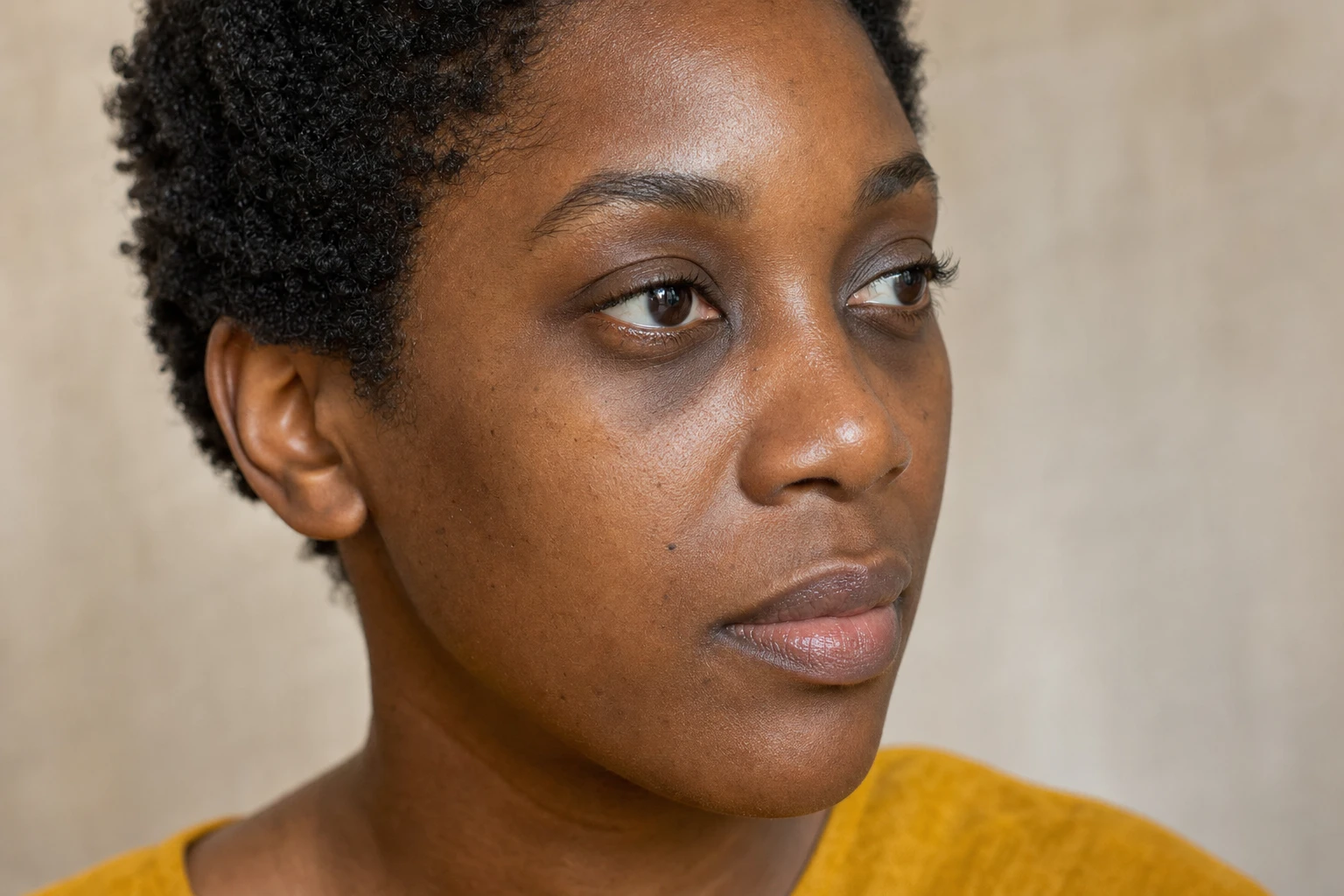
A dark circle can be identified by its colour and its contour. A pigmented dark circle is brown: it comes from excess pigment in the skin. A vascular dark circle is bluish to purplish: what you see are the blood vessels, and the blood pooling in them, through thin, translucent skin. A hollow dark circle has no colour of its own: it is the shadow cast by a hollow under the eye. In many people, two or all three of these causes occur together, and colour alone cannot tell them apart; a skin examination is needed to do that. That is why dark circle treatment starts by distinguishing what you are seeing, before any discussion of devices.
- What you see
-
A dark area under your eyes
- What only the doctor can tell on examination
-
- Pigment
- Blood vessels
- Hollowing
- How much each one contributes
Brown Dark Circles: What a Laser Can Target
When the colour comes from pigment, that pigment is what the laser aims to reach: its light is absorbed by the target and converted into heat. A laser for pigmented dark circles therefore makes sense only if the dark circle is truly brown because of excess pigment, and not bluish because of blood vessels or darkened by a hollow. For pigment under the eye, the options described are CO2 laser resurfacing and picosecond lasers, which are lasers with very short pulses.
CO2 resurfacing can lighten the colour under the eye, although this lightening does not necessarily correspond to a measured decrease in pigment. With picosecond lasers, improvement is possible, but it is not consistent: the pigmentation may also fail to fade. This is not enough to choose one laser over another for your skin. A brown dark circle can also have several causes, which the doctor can tell apart on examination.
- CO2 laser resurfacing
- Picosecond lasers
Bluish or Purplish Dark Circles: What a Vascular Laser Targets
A vascular laser directs its light at blood vessels. For a bluish dark circle, this is the logical target, since the colour comes from the blood vessels. The long-pulsed Nd:YAG laser is one of the techniques used for this component.
A vascular laser for dark circles aims to treat the component related to blood vessels: the wavelength must match this target. If brown pigment or a hollow is also present, the doctor must also take it into account during the assessment; a laser is no substitute for filler when a lack of volume creates the shadow. These lasers exist; CARE MD does not present them as an option for dark circles, and the same goes for picosecond lasers.
- Long-pulsed Nd:YAG laser
Hollow Dark Circles: Why a Laser Makes No Difference
A hollow casts a shadow, and no laser restores missing volume. For a hollow under the eye, adding volume is what is discussed, with filler considered case by case: this is injectable treatment for under-eye hollows. A hollow and discolouration are not treated the same way: one is related to volume, the other to pigmentation or blood vessels. If the hollow is the main cause of your dark circle, a laser therefore does not address the main problem.
- Filler
What a Laser Does: Target, Heat and Type of Resurfacing
A laser emits light of a specific wavelength. When the light reaches its target, it is absorbed and converted into heat; the choice of laser therefore depends on the intended target: pigment, blood vessels or skin texture. Resurfacing targets something else: the surface and texture of the skin.
“Fractional” describes something else: the energy is delivered in small microscopic columns of tissue rather than over the entire surface. This method can be ablative or non-ablative. Fractional CO2 laser is both ablative and fractional; the word “fractional” therefore indicates neither that the treatment is gentle nor that it is appropriate under the eyes.
A facial laser treatment is not automatically indicated under the eye: the skin there is thin, and both the area and the target must be assessed separately.
- Ablative
-
An ablative laser removes the outer layer of the skin and heats the layer beneath, which stimulates the production of collagen, the protein that gives skin its firmness.
The CO2 laser is an ablative laser. This stimulation does not, however, guarantee an effect on a dark circle.
- Non-ablative
-
Non-ablative resurfacing works without removing the surface of the skin.
It is less aggressive than ablative resurfacing, with a shorter recovery and a more subtle result. This general comparison does not tell you which approach is appropriate under the eye.
- Intense pulsed light
-
Intense pulsed light, or IPL, is not a laser: it emits several wavelengths at once, and eye protection must be adapted to these emissions.
For dark circles, it is one of the techniques, like fractional CO2, used to target skin texture and fine lines under the eye. This does not make it possible to attribute an improvement to any one of these techniques alone. Its suitability near the eye has yet to be established.
CO2 Laser Under the Eye: How It Works Does Not Establish That It Is Appropriate
You may have read that a CO2 laser improves dark circles.
A CO2 laser renews the surface of the skin. Under the eye, lightening is possible with ablative resurfacing; fractional CO2 can also reduce the dark appearance, but its effect is not consistent. It cannot be concluded that it is generally more effective than another approach. How long the effect lasts and the results according to skin colour have yet to be clarified.
How a laser works is not enough to say that it is appropriate under the eye.
Whether it is indicated depends on the thickness of your skin, its colour, what you want to change and how your skin heals, and a doctor makes that determination. The fact that a device is licensed in Canada does not tell you which area it is appropriate for either: ask what use it is licensed for and whether that use includes the area around the eye.
What the Doctor Checks During the Assessment, and What Has Yet to Be Confirmed
The assessment is first used to identify the components of your dark circles: pigment, blood vessels, hollowing, and how much each one contributes.
It can lead to laser treatment, another approach or a decision to do nothing.
During a Global Aesthetic consultation at CARE MD in Sainte-Thérèse, you can describe what bothers you under your eyes and compare these options. For the area under the eye, CARE MD's physician still needs to confirm three indications: those for ablative CO2 laser resurfacing around the eye, those for fractional CO2 laser under the eye and those for pulsed light near the eye. Until they are confirmed, CARE MD does not offer these treatments for dark circles. CO2 laser treatment is a medical procedure, performed by a doctor or by a nurse supervised by a doctor.
Thin Skin, Brown or Black Skin, the Eyes: What Changes the Decision
A laser works through heat. Even when well chosen, it can cause pain, redness, swelling and bruising; blisters, burns, infection and lighter or darker skin are also possible, and ablative resurfacing carries a slightly higher risk of scarring. Under the eye, where the skin is thin, these risks call for even more caution.
- Pain
- Redness
- Swelling
- Bruising
- Blisters
- Burns
- Infection
- Lighter or darker skin
- Scarring
On brown or Black skin, the risk of a lasting change in colour after resurfacing is higher. Yet under the eye, the aim is precisely to even out colour: a darker or lighter patch can therefore make what bothers you more noticeable. Other skin types are not exempt from this risk. This is not an exclusion, but choosing a device based solely on skin colour does not guarantee safety; the doctor guides the choice after examining your skin.
During laser treatment, the eyes must be protected. Ask how this protection is provided and how the skin is cooled. Protection reduces a risk without eliminating it, and it is no substitute for examining the area.
- Lasting change in colour after resurfacing
- Light skinBlack or brown skin
Higher risk on brown or Black skin
- Cold sores
-
Resurfacing can trigger an infection; the most common is a flare-up of the cold sore virus. If you get cold sores, say so: a preventive treatment can be prescribed before and after the procedure, but it must not be started on your own initiative.
- Keloid scars
-
If you already have keloid scars, the professional may advise against resurfacing.
- Complete list of your medications
-
Also provide a complete list of your medications, including those you have taken recently, and do not change how you take any of your medications without talking to the professional who prescribes them.
Preparing for the Discussion, What to Expect Afterwards and Your Expectations
What to expect afterwards varies with the type of laser.
After ablative resurfacing, the skin needs to heal, and aftercare is part of the treatment: apply only what the professional tells you to. After a non-ablative approach, the after-effects do not last as long. Sun protection remains necessary in all cases, because new sun damage can compromise the result of resurfacing. Side effects and recovery after facial laser treatment depend on the treatment performed and on your skin.
The number of sessions, recovery time and how long the effect lasts vary from person to person.
They depend on the target, the device and how your skin reacts. The professional explains what to expect and decides with you on the number of sessions. During an assessment, the doctor may also conclude that a laser is not the right option.
Other Approaches, Depending on the Target
- For a hollow
-
For a hollow, adding volume is discussed.
- When several causes occur together
-
When several causes occur together, approaches can be combined depending on how much pigment, blood vessels and hollowing each contribute.
- For resurfacing
-
For resurfacing, the non-ablative approach does not remove the surface of the skin.
It is less aggressive than the ablative approach, with a shorter recovery and a more subtle effect. Its suitability under the eye is evaluated separately during the assessment.
- Not treating
-
Not treating remains an option, especially when the risks outweigh the expected benefit.
- A drooping eyelid
-
Neither a drooping eyelid nor excess skin on the eyelid is a dark circle. Both fall within the scope of eyelid surgery, known as blepharoplasty.
Key Facts
- What a laser targets
-
Pigment, blood vessels or skin texture; never a hollow, which no laser fills.
- Who performs CO2 laser treatment
-
A doctor, or a nurse supervised by a doctor.
- Recovery
-
After an ablative treatment, the skin heals and requires care; after a non-ablative treatment, the after-effects do not last as long and the effect is more subtle.
- Sessions
-
The number varies depending on the target, the device and how the skin responds, and is decided with the professional who assesses you.
- How long the effect lasts
-
It varies from person to person, and new sun damage can compromise the result of resurfacing.
When to Call Right Away After a Treatment
Seek care right away
After a fractional CO2 laser treatment, call the professional who treated you if pain, redness or swelling increases instead of subsiding. Do not wait until your usual follow-up to report them.
Ask Us About Dark Circles and Laser Treatment
Frequently Asked Questions
Can a laser reduce all types of dark circles?
No. A laser acts on a specific target: brown pigment, blood vessels or skin texture. It does not fill a hollow, whose shadow is what darkens the under-eye area. Because these causes often occur together, a laser may treat only part of the problem. On examining your skin, the doctor can tell which cause predominates and whether another approach would suit you better, including doing nothing.
Sources4 references
Is there a vascular laser for bluish dark circles?
The technique exists. A vascular laser directs its light at blood vessels, which corresponds to the bluish or purplish colour of a vascular dark circle, and the long-pulsed Nd:YAG laser is one of the lasers that have been used for this component. Its aim is to treat the vascular component. Associated pigmentation or a hollow also needs to be assessed; a laser is no substitute for adding volume when a hollow causes a shadow. Under the eye, where the skin is thin, its role has yet to be established, and CARE MD does not present it as an option for dark circles. Like any laser, it can cause pain, redness, swelling and bruising.
Sources2 references
Can a laser lighten a brown dark circle?
When the colour comes from excess pigment, that pigment is the target a laser can aim at. CO2 laser resurfacing can lighten the colour under the eye, although this lightening does not necessarily correspond to a measured decrease in pigment. Picosecond lasers can improve pigmentation, but it may also remain unchanged. None of these results tells you automatically which technique to choose for your skin. On brown or Black skin, the risk of a lasting change in colour is higher. During the assessment, the doctor therefore begins by confirming that the dark circle is in fact pigmented and not hollow or vascular.
Sources4 references
I have read that CO2 laser improves dark circles: is it a suitable treatment for them?
A CO2 laser is ablative: it removes the outer layer of the skin and heats the layer beneath. It can lighten the colour under the eye; with fractional CO2, some reduction is possible, but it is not consistent. How long the effect lasts has yet to be clarified. How the laser works is not enough to establish that it is indicated for your skin. Under the eye, CARE MD's physician still needs to confirm the indications for ablative CO2 resurfacing and fractional CO2 before CARE MD offers them for dark circles. During the assessment, the doctor determines whether this laser makes sense for your skin or whether another approach would serve you better.
Sources3 references
Why do under-eye skin and brown or Black skin require more caution?
A laser works through heat, and under the eye the skin is thin: burns, blisters, infection, scarring and changes in colour are risks to weigh carefully. On brown or Black skin, the risk of a lasting change in colour after resurfacing is higher, and a darker or lighter area is especially noticeable where the aim is to even out colour. This is not an exclusion: choosing a device based solely on skin colour does not guarantee safety, and the doctor guides the choice after examining your skin.
Sources2 references
How many sessions does it take, what is recovery like and is the effect permanent?
No single number of sessions applies to everyone: it depends on the target, the device and how the skin reacts, and the professional who assesses you sets it with you. After ablative resurfacing, the skin needs to heal, with aftercare to follow; after a non-ablative approach, the after-effects do not last as long and the result is more subtle. How long the effect lasts varies from person to person, and new sun damage can compromise the result of resurfacing, hence the need for sun protection.
Sources2 references
What does the doctor check during the assessment, and can they conclude that a laser is not the right option?
During the assessment, the doctor begins by identifying the causes of your dark circles, and then checks the condition and thickness of the skin under the eye, your skin phototype, your medical history, how your skin heals, any cold sores, your medications and your previous skin care. The doctor may conclude that a laser is appropriate, that another approach suits you better or that it is better to do nothing. At CARE MD, the Global Aesthetic consultation is the opportunity to discuss this.
Sources3 references
Sources9 references+
- Cosmetic Laser Treatments, Health Canada (opens in a new tab)
- Laser resurfacing, Mayo Clinic (opens in a new tab)
- Laser Hair Removal - Safety Guidelines for Facility Owners and Operators, Health Canada (opens in a new tab)
- Clinical analysis and classification of dark eye circle, Huang et al. (opens in a new tab)
- Periorbital Hyperpigmentation—Dark Circles under the Eyes; Treatment Suggestions and Combining Procedures, Goldman, Goldust and Wollina (opens in a new tab)
- Comparison of the efficacy of carboxytherapy versus fractional CO2 laser therapy for the treatment of periorbital dark circles: A randomized clinical trial, Zaheri et al. (opens in a new tab)
- Improvement of infraorbital hyperpigmentation following carbon dioxide laser resurfacing, West and Alster (opens in a new tab)
- Prospective studies of the efficacy and safety of the picosecond 755, 1,064, and 532 nm lasers for the treatment of infraorbital dark circles, Vanaman Wilson et al. (opens in a new tab)
- Skin Care Before and After Fractionated Carbon Dioxide Laser Treatment, Memorial Sloan Kettering (opens in a new tab)
Laser Under the Eye: Treatment Limitations and Precautions
Laser treatment under the eye is a medical procedure on thin skin: an assessment of your skin, your medical history and your medications comes before any choice of device.
Limitations and precautions
Mention any cold sores, keloid scars, illnesses, medications, and previous skin care and treatments.
A preventive treatment for cold sores must not be started unless it is prescribed for you.
The eyes must be protected during laser treatment: ask how this is done, and how the skin is cooled.
Protect your skin from the sun after a treatment and apply only the products specified by the professional.
After a fractional CO2 laser treatment, call your care provider if pain, redness or swelling increases; do not wait for the usual follow-up.
No result is guaranteed. Neither a change in the colour of the dark circle nor how long the effect lasts is guaranteed.
A laser is no substitute for filler when volume is lacking. The intended target — pigment, blood vessels or texture — guides the choice of technique.
The number of sessions and recovery vary depending on the device and the person.
The risks are pain, redness, swelling, burns, infection, scarring and changes that make the skin darker or lighter and can be long-lasting on brown or Black skin.
For the area under the eye, the indications for CO2 laser and pulsed light have yet to be confirmed by CARE MD's physician.
