


skin tone & redness
What Is Hyperpigmentation? Recognizing Brown Spots and When to See a Doctor
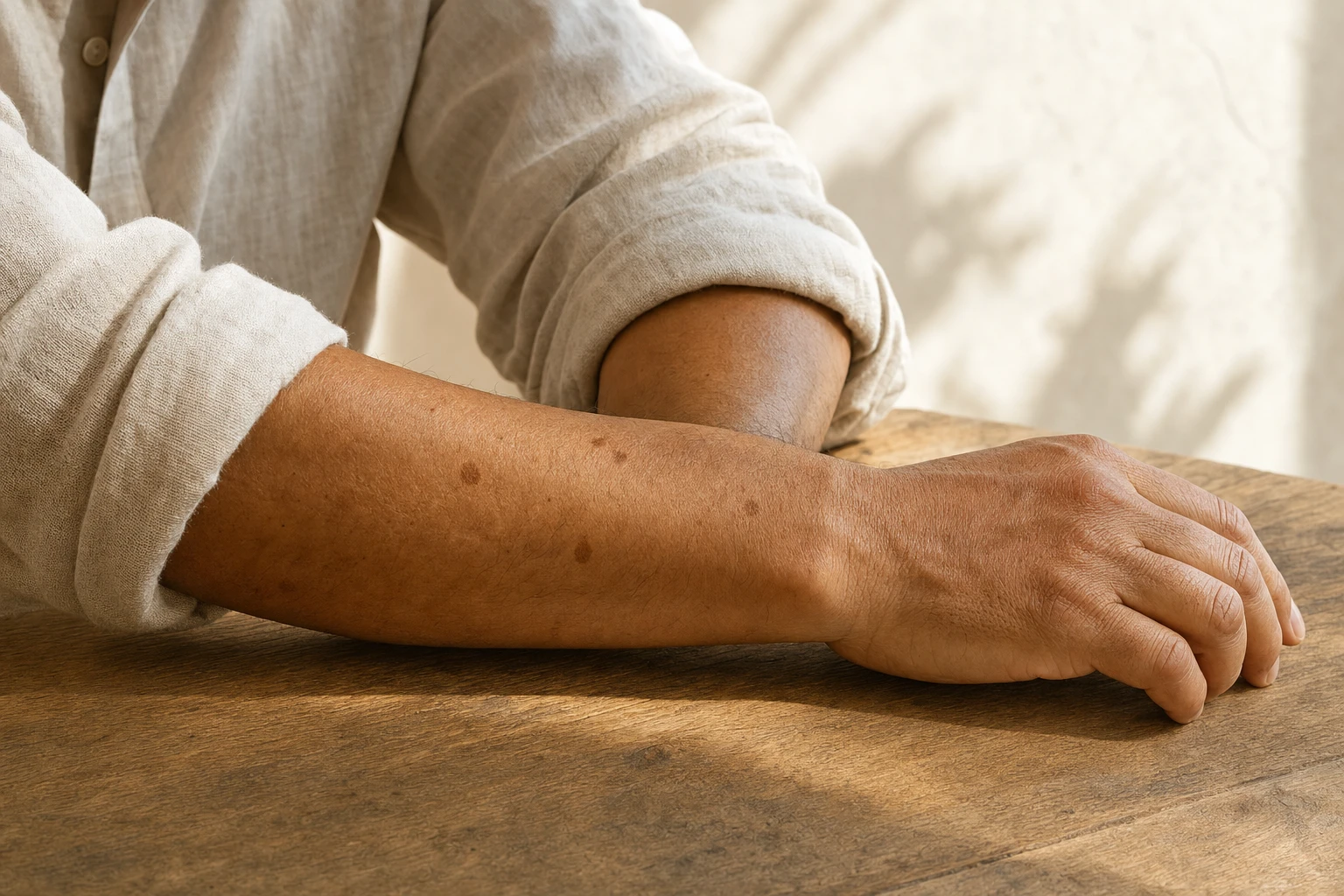
In Brief
- What it is: an area darker than the surrounding skin. When it comes from an excess of melanin, the skin's pigment, it is called hyperpigmentation. Its colour alone does not tell you what it is.
- What it could be: a freckle, a solar lentigo, melasma, a mark left by inflammation, a seborrheic keratosis or a mole. Only the doctor can tell them apart on examination.
- When to have it examined: a spot that is new, different from the others, changing, itchy, bleeding or not healing, or that shows one of the ABCDE signs.
- Who to see: a doctor, who examines the skin. A photo, a text or an online form is no substitute for that examination.
- Afterward: how much a mark can be faded depends on its cause, with no promise that it will disappear. Once the spot has been examined, what comes next is discussed at CARE MD in a Global Aesthetic consultation.
You have noticed a brown spot on your skin, on the face or on the body, and you want to know what it is and whether a doctor should see it. A spot is an area darker than the surrounding skin. What is hyperpigmentation? When a spot comes from an excess of melanin, the pigment that gives skin its colour, it is called hyperpigmentation. A brown mark can also be a different kind of lesion. Neither colour, nor shape, nor a photo found online is enough to identify a spot, and a misleading resemblance can even cause a skin cancer to be missed.
A Darker Area: What Colour Does and Does Not Tell You
Whether a mark is described as brown, dark brown or black, or as a pigmented spot, these terms describe its colour. Sun exposure, inflammation or hormonal changes can contribute to pigmentation. But a brown lesion is not always caused by a simple excess of pigment: two marks of the same shade can be different kinds of lesions.
Where it is located gives some indication. Sun exposure mainly affects exposed areas; on the body as well as the face, a mark can also result from a pimple, irritation or an injury.
Flat or Raised: The Most Common Marks
The freckles are small, flat marks ranging from light to dark brown. They become more noticeable in summer and fade in winter, and their number can increase after exposure to the sun's ultraviolet rays. Their seasonal changes distinguish them from lentigos, but are not enough to identify the mark you are looking at.
A solar lentigo is usually a flat mark that appears mostly on sun-exposed skin after years of exposure to ultraviolet rays. Unlike a freckle, it usually persists all year. However, not every persistent spot is a lentigo. If the mark is raised or you are unsure what it is, have it examined by a doctor: looking like a lentigo is not enough to identify it.
The condition known as melasma causes patches that are darker than the surrounding skin, most often on the face. It can appear during pregnancy or when hormonal contraception is started. Other conditions look similar: the context alone is not enough to identify it. It sometimes fades on its own, but can also last for years.
After a pimple, an irritation or an injury, the skin is sometimes left with a darker mark: this is post-inflammatory hyperpigmentation, the spot that remains after the pimple. A pimple or an injury can leave this mark, but that is not enough to identify it. If a spot appears without any inflammation that could explain it, do not assume it is the same thing.
Seborrheic keratosis often has a rough surface and a colour that ranges from pink to almost black. It looks stuck onto the skin, as if glued on. Flat at first, it often becomes more raised and wider over the years. Not every raised mark is one, and a very dark keratosis can look like a melanoma: a brown or black lesion that changes should be examined.
A mole can be flat or slightly raised, and these features are not enough to identify it with certainty. Unlike a mark left by inflammation, a new mole or one that changes in an adult can be a sign of melanoma. Have it examined by a doctor.
A dry, rough, scaly mark is not necessarily a spot: it may be an actinic keratosis, which may develop into skin cancer. It should be examined, not treated as a mere blemish.
Where the Mark Comes From: Sun, Inflammation, Hormones
To help the doctor, describe what happened before the spot appeared; you do not have to identify it yourself. Exposure to ultraviolet rays can increase the number of freckles, while years of exposure contribute to solar lentigos. Inflammation can also leave a mark, whether it comes from a pimple, an injury or a product that irritates the skin. For melasma, pregnancy or the start of hormonal contraception can be part of the picture. Several of these causes can occur together in the same person, and none applies to every spot.
On medium to dark skin tones, various triggers stimulate the skin to produce more melanin, and irritation from a skin care product sometimes leaves a darker mark. Whatever your skin colour, do not put a new or changing spot down to irritation without having it examined.
When Should a Brown Spot Be Examined?
The five ABCDE signs indicate when to ask for medical advice. They help you notice a change, not make a diagnosis. A spot may need to be examined even if none of these signs appears.
- Asymmetry
-
One half of the spot does not look like the other.
- Irregular borders
-
The outline is scalloped or poorly defined.
- Uneven colour
-
The colour varies from one part of the spot to another. A uniform colour does not guarantee that the spot is harmless.
- Diameter
-
Melanomas are often more than 6 mm at the time of diagnosis, but some are smaller; a small diameter is therefore not reassuring on its own.
- Evolution
-
The spot is different from the others, or it changes in size, shape or colour.
Other signs matter even if no ABCDE sign appears: a new spot, a spot that itches or bleeds, a sore that does not heal or that comes back after healing. A single one of these signs is enough to justify an examination. The ABCDE signs help recognize a melanoma, without replacing the examination: a change or a suspicious feature calls for medical advice.
Seek care right away
A spot that is new, different from the others, that changes, itches or bleeds, or a sore that does not heal, calls for a medical examination. Do not wait for a response to a form or for an aesthetic treatment to have it examined. Neither its colour nor a photo is enough to determine in advance that it is cancer or to rule cancer out: a doctor examines the skin and decides what comes next.
Who to See and What to Prepare Before the Examination
In Canada, the assessment of a suspicious spot usually begins with the family doctor: they ask questions, examine the skin and may refer you to a specialist. If you notice a change in your skin, tell them promptly.
Before the appointment, note when the spot appeared, how it has changed, whether it itches or bleeds, and whether you or a close family member have ever had skin cancer. This information helps the doctor understand how the spot has developed; the doctor also has to examine the skin.
Comparing your spot with photos found online is no substitute for an examination: two marks that look alike can be very different. The CARE MD form is for asking a question about an aesthetic treatment, not for having a spot assessed. If your spot shows one of these warning signs, have it examined by a doctor first.
Fading a Mark: What Helps, What Irritates
Whether a mark fades depends on its cause. When the trigger goes away, for example when inflammation settles, some marks fade; a lentigo usually persists, and melasma can fade on its own or last for years. No timeframe applies to every spot, and there is no guarantee that a spot will disappear. Have the spot identified before choosing a lightening product: that label alone does not tell you whether it suits you. A new or changing spot must first be examined by a doctor.
A broad-spectrum sunscreen of SPF 30 or higher protects the skin from ultraviolet rays; reapply it at least every two hours while exposed, and more often if you sweat, swim or towel off. A wide-brimmed hat adds to this protection outdoors. This protection limits the effect of the sun on the skin; it does not guarantee that a spot will disappear.
Gentle care is preferable: a product that burns or stings irritates the skin, and irritation can leave a darker mark or make one more pronounced. Stop using it and ask for advice. So-called natural remedies follow the same rule: “natural” does not mean harmless, and no remedy guarantees an effect on a spot. Avoid trying one product after another on a spot when you do not know what it is.

After the Examination: What Comes Next at CARE MD
Once the mark has been examined and identified as pigmentation, you may want to fade it. On the face, the assessment of brown spots on the face is an opportunity to discuss suitable options, their limitations and their risks. You can discuss these in a Global Aesthetic consultation at CARE MD. An aesthetic treatment must never come before the examination of a new or changing mark.
Examining a Spot: The Limits of Written Information and When a Doctor Is Needed
A spot is assessed through an examination, not by its colour or its description.
A spot that is new, different from the others, changing, itchy, bleeding or not healing must be examined by a doctor before any aesthetic treatment.
A mole that changes and a dry, rough, scaly mark should be examined, not treated at home.
Stop using a product that causes burning or stinging, and ask for advice.
Tell a doctor about your personal or family history of skin cancer.
Avoid trying one product after another on a spot when you do not know what it is.
No text, photo or form can tell you what kind of lesion it is.
The ABCDE signs are warnings; their absence rules nothing out.
There is no guarantee that a mark will disappear: whether it does depends on its cause.
Sunscreen protects against ultraviolet rays. Sun protection does not guarantee that a spot will disappear.
Frequently Asked Questions
What can a brown spot on the skin be?
An area darker than the surrounding skin. When it comes from an excess of melanin, the pigment that gives skin its colour, it is called hyperpigmentation. However, this is not the cause of every brown mark. It may be a freckle, a solar lentigo, melasma, the mark left by a pimple or an irritation, a seborrheic keratosis or a mole. The colour brown describes what you see; it does not tell you what the spot is. Only a doctor can tell, on examination, because a visual resemblance can cause a skin cancer to be missed.
When should a spot on the skin be examined?
When it is new, different from the others, changes in size, shape or colour, itches, bleeds or does not heal. The ABCDE signs are also warnings: asymmetry, irregular borders, uneven colour, diameter, evolution. Their absence rules nothing out, and a small diameter is not reassuring on its own. If you notice any of these signs, seek care right away from a doctor, without having an aesthetic treatment first or waiting for a response to a form.
Can a spot on the skin disappear?
It depends on its cause. A mark left by inflammation can fade when the irritation stops, melasma can fade on its own or last for years, and a lentigo usually persists. No timeframe applies to every spot, and there is no guarantee that a spot will disappear. Before trying anything, have the spot identified: a new or changing mark must be examined first.
Do natural remedies work on a spot on the skin?
No remedy is guaranteed to have an effect on a spot. The word “natural” does not mean harmless, and irritation can leave a darker mark or make one more pronounced. If a product burns or stings, stop using it and ask for advice. Avoid trying one product after another on a spot when you do not know what it is, and have any new or changing spot examined before applying anything.
Is a photo enough to know what a spot is?
No. Two marks that look alike can be very different, and a reassuring resemblance can hide a skin cancer. Comparing your spot with photos found online is no substitute for an examination, and no form can provide a remote diagnosis. To find out what it is, a doctor must examine the skin.
Is a flat spot necessarily harmless?
No. Many flat spots are benign, such as freckles or solar lentigos, but a flat mark can also be a mole that is changing or a melanoma. Shape alone is not enough to identify it. A uniform colour guarantees nothing either, and a small diameter is not reassuring on its own: what matters is how the spot changes and a doctor's examination.
Who should look at a spot that worries me?
A doctor. In Canada, the assessment usually begins with the family doctor: they ask you questions, examine the skin and may refer you to a specialist. Before the appointment, note when the spot appeared, how it has changed, whether it itches or bleeds, and whether you or a close family member have ever had skin cancer.
Sources14 references+
- American Academy of Dermatology — How to fade dark spots in darker skin tones (opens in a new tab)
- DermNet — Ephelis (opens in a new tab)
- DermNet — Solar lentigo (opens in a new tab)
- American Academy of Dermatology — Melasma: Overview (opens in a new tab)
- British Association of Dermatologists — Seborrhoeic keratosis (opens in a new tab)
- American Academy of Dermatology — Moles: Signs and symptoms (opens in a new tab)
- American Academy of Dermatology — Moles: Overview (opens in a new tab)
- American Academy of Dermatology — Seborrheic keratoses: Tips for managing (opens in a new tab)
- American Academy of Dermatology — What to look for: ABCDEs of melanoma (opens in a new tab)
- Canadian Cancer Society — Finding skin cancer early (opens in a new tab)
- Canadian Cancer Society — Diagnosis of melanoma skin cancer (opens in a new tab)
- Canadian Dermatology Association — Check Your Skin (opens in a new tab)
- Health Canada — Sunscreens (opens in a new tab)
- Health Canada — About Natural Health Products (opens in a new tab)

A Question Before You Decide?
Has your spot been examined, and do you want to talk about how it looks? You can book an assessment in a Global Aesthetic consultation at CARE MD.